Exercise 1: Place. London: Thames and Hudson by Dean, T, and Millar, J. (2005)
Reading notes:
Our perception of “place” or the “zone” is subjectively dynamic and depends of our moods, feelings and emotions.
‘While we might certainly be lost in a place, we would certainly be lost without it ‘. ( page 12 )
‘When space feels thoroughly familiar to us, it has become place’ Yi-Fu Tuan, 1976 ( page 14 ).
Place is something that is known to us, somewhere that belongs to us is a ( spiritual ) sense and to which we belong,’ Thomas Hardy, 1887 ( page 14 ).
Many Historical event are known by the place where they occured, Hiroshima, Chernobyl, Auschwitz. ‘Places remember events’, James Joyce, ( page 14 ).
Like the landscapes themselves, our understanding of landscape has changed over time, and this is true also of place.
‘Place is all-important because, there is nothing outside of place.’ Place is all that there is, the limit of all things and in this it might be considered as a divine being. Arostotle, ( page 14 ).
Place is perceived as in some sense ‘bounded’, particularly in relation to the seemingly endless extension of space ( page 18 ).
A place or a work of art can retain a profound importance for us regardless of whether we own it or not, indeed, whether we have seen it or not.
Not every place that is made it art, however; but to make art is to make place ( page 26 ).
‘Everything is somewhere and in place’ Aristotle ( page 26 ).
Research Point – Place. London: Thames and Hudson by Dean, T, and Millar, J. (2005)

Vitaly Komar and Alex Melamid’s Post Art No. 1 (Warhol), 1973
Available at : https://www.artsy.net/artwork/komar-and-melamid-post-art-no-1-warhol
Accessed: 15/04/20
An appropriation art piece of Andy Warhol’s signature Pop-art. I believe the intention was a statement on the transiency of modernity, choosing to recreate the work in a state of decay and disintegration.
Ian Hamilton Finley, ‘Little Sparta’, 1966 Finley is a true ‘Concrete and landscape poet’. His work incorporates text, sculpture, landscape and poetry and the result is very special and stunning. The article mentioned his fantastic poetry Garden work as an entire ‘place’ was created by using the text as a physical, integral, building block of his art.
Nicolas Sloan is an interesting lettering artist, working mainly in stone block carving / engraving. I’ve chosen his stone path installation although I couldn’t find the work’s name. Text carved in stone truly dominates a place, immediately associates with tombstones or a type of memorial, intriguing the viewer to take the pathway and follow the text.
Douglas Huebler, Crocodile Tears series 1984, ink and printed paper collage on paper on board. Hueblers comic art is both humorous and witty, it includes text, charaters and timeline therefore creating a full story, existing in it’s own time and place.
Dan Graham, Time Delay Room, 1974 Graham examines some experimental ideas involving the place of instructional texts: from a necessary banality, is taken into the visual front line of original conceptual art.
‘The Robert Smithson piece, A Heap of Language This work is composed of a total 152 words arranged in 20 lines forming a pyramidal shape. The work examines the boundaries between word and form and the two simultaneously existing in separate visual dimensions: shape and drawing vs. word and reading.
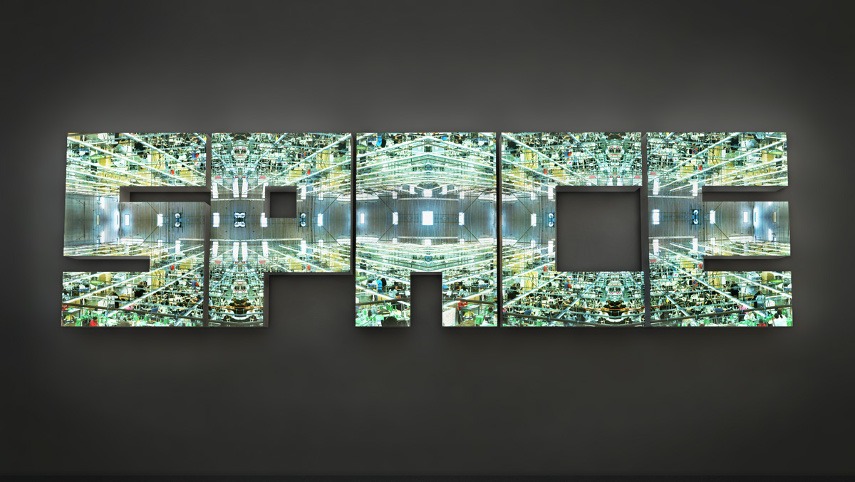
Doug Airken Works in an array of media, including photography, video, sound, and sculpture. Some of his works use text, as the actual canvas, screen or the space where his art takes place. The outcome is very powerful : Doug Aitken – Space – Image Link: https://d2jv9003bew7ag.cloudfront.net/uploads/Doug-Aitken-Space-Image-via-pinterestcom.jpg
Roni Horn, The Dog’s Chorus. Let Slip a Bat Out of Hell (2016). Horn skillfully uses text as a graphic media and building block of the places she takes us to in her artwork. Her work would also qualify as another form of ‘concrete poetry’.
Marine Hugonnier, explores the relationship between text and image, the descriptive and the deceptive. By removing and replacing newspaper photographs with blocks of color, she created a new function, place meaning outside the original purpose of commerce, propaganda and ideology.
Exercise 2: Developing your research skills
Notes on Katie Paterson’s ‘Vatnajökull’ (the sound of)
The piece connects listeners, rather than viewers to a distant and remote place using sound over a telephone line.
We could define the project’s medium as ‘sound’ and technological social science, the lines used to connect listeners from anywhere to a specific ‘place’ as well as forming a relation with the urgent issues our place is facing. symbolically, the project connects us to nature and the entire reality of global warming.
Researching other works by Katie Peterson:
All the dead stars (2009)
Campo del Cielo ( Field of the sky ) 2012
Future Library (2014)
Earth-Moon-Earth (2019)
In general, Katie Peterson is a conceptual scientific artist. Each of her project involves multiple philosophical exploration of space, time and nature. Her inquisitive projects include a very scientific point of view and research. Usually involving scientists as well as craftsmen ( or women ).
Future library, is a bit like ‘long player’, an art project extending over 100 years, involving place, time and an entire social community of forest care takers. As well as multiple writers who donated the capsuled texts, or manuscripts for the future library project.
In her latest work: ‘Earth-Moon-Earth’ (2019). Peterson
Exercise 3 : Gallery or site visit
Keosocheat Koem – (2020) ‘ Eyes of Mercy’ art exhibition at K’bach Gallery, The Factory Phnom Penh
The exhibition features Keosocheat’s collection of cat oil paintings, blending images of her cats into expressions of fantasy, her imaginative world and social interpretation. I’ve chosen 2 pieces that appealed to me for this exercise:
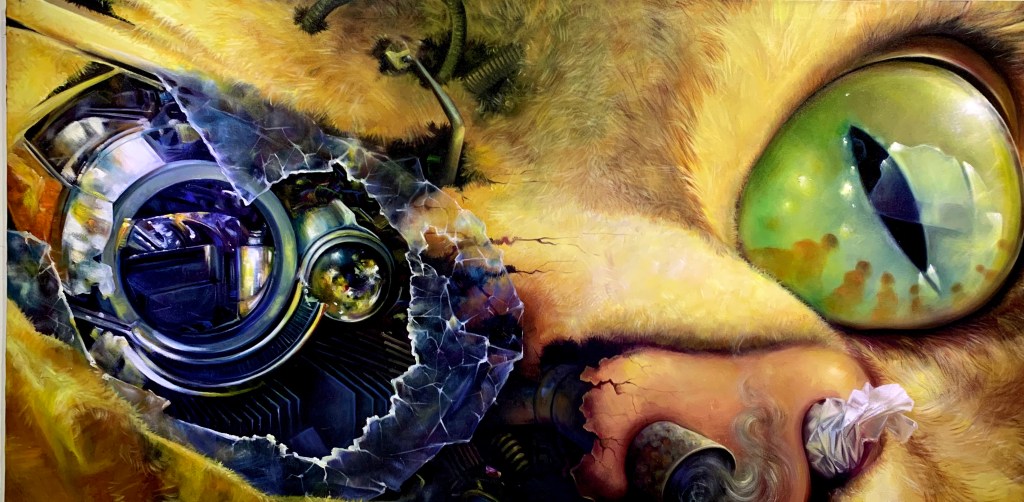
“Which eye do you prefer ?
One eye, creative, expensive and modern but merciless.
The other eye filled with romance, love and affection.”
Poem by Keosocheat Koem as part of her collection.
A cat face, with one natural eye and an evil looking camera lens, replacing the other through shattered glass. The nose is blocked by litter and a smoking bud.
There was no artist notes attached to the works. My observation is that is a representation of local Cambodian issues such as oppression and pollution. As well as a representation of the conflict between the natural world and the mechanical and polluted human world.
I additionally observed Socheat’s admiration and reverence for nature / animals welfare, including her beloved pets that dominate the theme of her artwork. Motifs of urbanism, pollution and mistreatment are noticeable throughout her artwork, but it doesnt seem that she dwells on the negative and leaves room for the observer to develop their own response and imaginative interpertation.
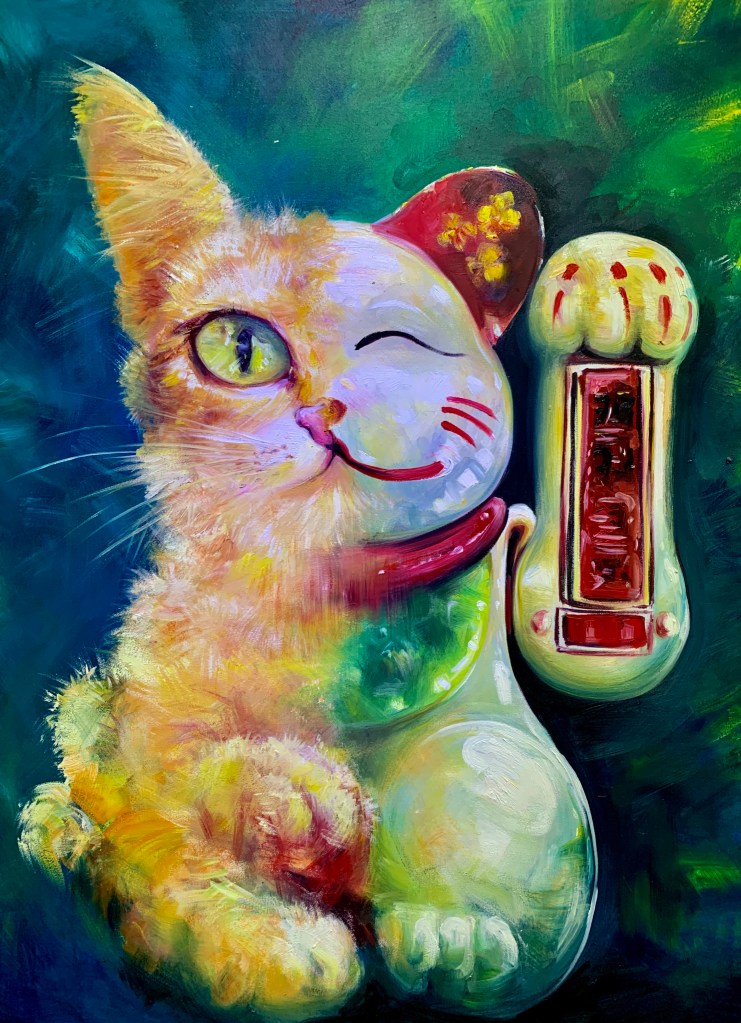
( 2019 )
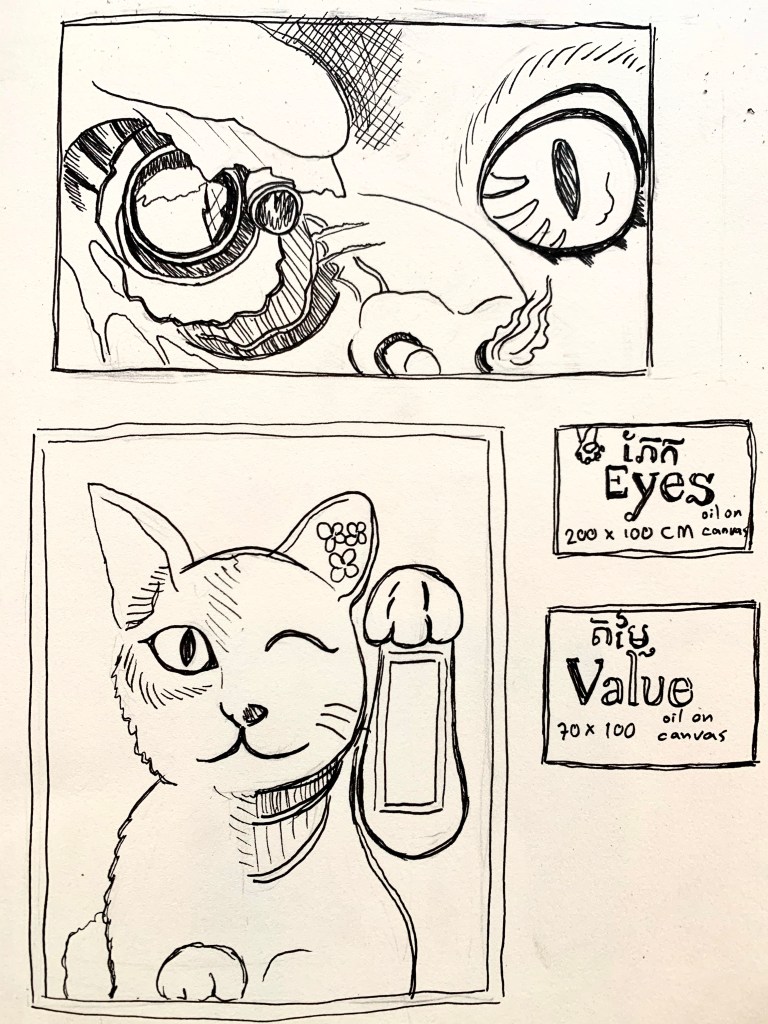
Keo Socheat ‘Value’ oil on canvas , K’bak gallery
In the second example of a cat painting by Keosocheat, we view a realistic cat infused with a Japanese ‘fortune cat’ statue. My impression, as well as the title indicates that the she is questioning the ethics and morality of local superstition. Perhaps she is expressing the special role her feline companions hold in her heart.
The artist: Keosocheat was born in the beautiful province of Kampot in 1993, she graduated from the prestigious Royal University of Fine Arts ( Phnom Penh ) in 2018. While studying, she would visit galleries and spent hours exploring and developing the ‘soul’ of her paintings. After graduating she dedicated an entire to developing her debut exhibition; ‘Eyes of Mercy’, a series of cat paintings in oil. demonstrating the artist’s skills and creativity, with 29 original artworks of cats painted in the company of her own cats. More importantly, Keosocheat would like to use her artwork as a vehicle to raise awareness on animal rights in Cambodia.
Her art would best fit into the surrealism category. She paints in oil, Blending realistic elements into her own vision and fantasy.
Text In Visual Art – Research Point notes
Works form the early twentieth century where appropriated words, letters and symbols were increasingly incorporated, , reflected the emerging avant-garde movements of the time. This period also saw an increasing presence of the printed word in the urban landscape and the developing sophistication of marketing and advertising.
Kurt Schwitters’s Mz.299 192
Picabia, Schwitters and Marcel Duchamp were all associated with the dada movement and rejected traditional art materials. In Duchamp’s seminal work Fountain 1917, replica 1964, he incorporates the name R. Mutt. Here he uses text in its traditional sense by indicating authorship; however R. Mutt is the name of the factious artist -Duchamp’s pseudonym.
it was Sol LeWitt who first coin the term ‘conceptual art’ in the article Paragraphs on Conceptual Art, 1967. LeWitt, along with the text-based artists Joseph Kosuth, Art & Language, Hamish Fulton and Richard Long, represented a fundamental strand in the conceptual art movement.
In the late 1960s and early 1970s conceptual art was established as a category or movement and language was a central concern for artists such as Ed Ruscha and Lawrence Weiner.
Conceptual art presented a shift towards ideas and systems that invited the viewer to engage with an intellectual concept.
Lawrence Weiner’s use of language and words focuses on the interaction between the artwork and the ‘receiver’ – the audience who encounters the work in some form.
The artist’s aim is to offer a universal, objective experience in which the reader is invited to execute the work through his or her own imagination.
Edward Joseph Ruscha IV (, roo-SHAY; born December 16, 1937) is an American artist associated with the pop art movement. He has worked in the media of painting, printmaking, drawing, photography, and film. Ruscha lives and works in Culver City, California. “The words have these abstract shapes, they live in a world of no size,” noted Ed Ruscha in relation to his early single word-works which often employ visual alliteration.
Bruce Nauman’s colourful neon text-pieces are frequently self-referential and equally as playful as Ruscha’s paintings and prints.
Martin Creed is often referred to as a conceptual artist in the minimalist tradition. Creed uses language to unsettle and amuse – both words are always apparent to the viewer yet need one another to comfort.
The Italian artist Mario Merz began using neon in 1966, his neon texts were often juxtaposed against everyday objects.
This critical reflection on modern society is also evident in Jenny Holzer’s work through her witty and provocative slogans which reference to everyday experiences and emotions.
Holzer belongs to the feminist branch of a generation of artists that emerged around 1980, looking for new ways to make narrative or commentary an implicit part of visual objects. Her contemporaries include Barbara Kruger, Cindy Sherman, Sarah Charlesworth, and Louise Lawler.
While Holzer is known for inserting her political statements into the public sphere, the German artist Joseph Beuys is lauded for his role using art for social transformation. Much of Beuys’s work was focused on the environment – many of actions would take place in the landscape.
While some of Richard Long’s walks are recorded by a photograph others, such as In the Clouds 1991 are text based. These pieces are sparse in nature, with a handful of words chosen to describe the long walks the artist makes all over the world.
Artists have, of course, also looked to language for its poetic impact and literary resonances. Concrete poets, including Ian Hamilton Finlay, explored the formal qualities of language through its visual arrangement on a page, creating sculptural works with embedded text.
Finlay was also drawn to how language shapes the world in which we live and his sculptural works entwine references to nature, the Romantic sublime and history through a combination of deftly chosen objects, poems and sentences. The garden Little Sparta, perhaps his tour de force creation, in the Pentland Hills near Edinburgh is littered with aphorisms, poems and references to ancient Greece and particularly the rivalry between Athens and Sparta.
Like Finlay, Cy Twombly was equally fascinated and inspired by Mediterranean heritage. Twombly first travelled to Italy and North Africa in the early 1950s and settled there in 1957. Throughout his career Twombly referenceed classic literature and mythology, while blurring the lines between painting and writing.
The two artist I would like to highlight as most interesting in my view are : Ian Hamilton Finley and Sol Le Witt
Case study : ‘Nathan Coley a Place Beyond Belief’
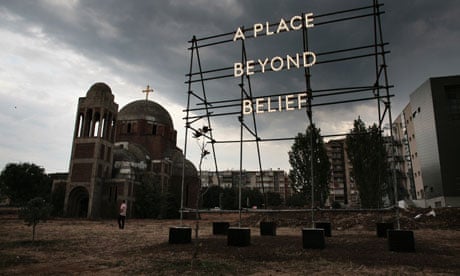
My initial responses:
My initial mental response, was viewing yet another American, Vegas style, road side sign. The text message created a wish to learn more on the context and possible meaning of the piece.
Questions I have:
What is the message and context of this text ? What place exists beyond belief ? Where is the sign located and what are the buildings in the background ?
Type of Art category:
It looks like a conceptual / philosophical questioning art installation incorporation text and everyday objects ( The lights and scaffolding ).
Initial interpenetration:
I can guess the text might symbolize a certain emotion, state of mind or situation, the artist wished to address and let the viewers reflect on.
Study Notes:
Nathan Coley is a Scottish artist who creates work that questions how we relate to public spaces and architecture.
Born in Glasgow in 1967, Coley studied at the Glasgow School of Art from 1985 to 1989. He currently lives and works in Glasgow.
Coley’s works explore architecture and religion, although he is more interested in what is built by whom and where and why than the building itself. Likewise, he holds no formal faith.
‘I’m always looking for a new text: anywhere, everywhere. I’m never the author. The texts always need to come from the world.’ Nathan Coley.
The use of the ‘ready-made’ ( existing object or element.) is a recurring idea in Nathan Coley’s work & practice.
A Place Beyond Belief 2012 consists of a scaffolding structure with four words; A Place Beyond Belief, spelled out in illuminated light bulbs. The words don’t make up a traditional sentence as there is no verb or punctuation and it is written in capital letters. The work immediately makes the viewer question where this ‘place’ is, and what belief does the artist mean?
• My Thoughts following the monologue:
Coley’s Monologue helped answer some of my questions: It shed light on the piece and included additional meanings, depth and context on was previously mysterious text piece.
•Other information found on Coley’s website:
The source of the text for A Place Beyond Belief is a story the artist heard recounted on a radio programme commemorating the tenth anniversary of 9/11. A woman recalled the collective hatred and hostility directed towards a Sikh man. Feeling shame and sadness over how this man was received and treated, the woman noted that for New York to recover it needed to become ‘a place beyond belief’.
• Where is it actually sited?
In 2012 A Place Beyond Belief was installed in a park in Pristina, the capital city of Kosovo. Sitting beside an unfinished church built during the oppressive regime of former Serbian president Slobodan Milošević, the text can be read in a number of ways, including as a potential testimony to the misuse of religious belief. The work has also been shown in Freiburg Germany and at Haunch of Venison, a contemporary art gallery in London.
• Did this alter my response ?
My initial response to the piece was quite ambivalent, as it was hard for me to connect or develop feelings with something I could not fully understand. Once I had more information on the meaning of the text, I could feel more for the piece as well as the artist’s message.
• How my views changed after listening to Coley speak about it? If so, why?
Coley’s words changed my view entirely, as I was previously ambivalent towards his work. Hearing him revealed his insight and ideas, which really helped me further relate to his statements on tolerance, social activism, religion and justice.
“A Place Beyond Belief is multi-vocal,” he says, “it could even be read as antagonistic. At the same time, sited by the church that Milosevic started to build, it stands as a testimony not to religious belief, but the misuse of religious belief. It is also next to the library: between a beacon of hope and a beacon of destruction.”
I believe context & information should essentially be available in case one wishes to investigate an art piece following their viewing. However, despite the benefits of the contextual knowledge there is an equal pleasure in approaching this kind of art without any background knowledge. This allows viewers to make own analysts & meaning before discovering more about the artist intention. In conclusion, context info should probably be available, yet hidden from obvious site.
• A place Beyond Belief may initially seemed a simplistic text based sculpture, yet once we have revealed both the stories behind the message and chosen placed location. It achieves a great deal of criticism and contemplation on society, superstition, religion & activism. There is a space for each viewer to feel and create his/her own impression on Coley’s message. This was certainly the case for me.
•I can observe several repeating motifs in Coley’s work. There are several other contextual quote works similar to ‘A place beyond belief’, such as ‘You Imagine What You Desire’ and’The Same For Everyone’. All seem to make strong statements on social injustice, equality and religion. There are also multiple architectural and geometrical sculptures.
Pick two or three other pieces that look interesting to you. His site is comprehensive, with linked reviews and articles and often video clips which can give you a more realistic view of the siting of a piece
I enjoyed the extra details on his other works from the Haunch of Venison: ‘The Honours Series’ 2012, and ‘Unnamed’ 2012


I can definitely note connections across his works, use of the letter / text and messages. Additionally, there’s intentional censorship / omission of certain elements in order to amplify the statements as well as encourage viewers to develop their own interpenetration.
Coley’s work seems to be driven by his creative mind and motivated by his own senses and reflective ideas. He captures ideas during moments of inspiration: This could be driven by every days experiences, such as overhearing conversations, media stories etc.
Conclusion
Throughout my life, I never felt attracted to appreciating contemporary / conceptual art. I could say I was even slightly averted as certain aspects of modern art seemed pretentious and driven by artificial hypes and a money driven and commercialized of the modern art world.
As I decided to approach our course materials with an open mind, certain works showed me new complex emotional aspects of contemporary art. Which in general expanded my views and dissolved certain negative impressions I might’ve previously possessed.
Of the works we viewed and researched, I felt most inspired by Katie Paterson’s works: ‘Vatnajökull’ (the sound of) and Earth-Moon-Earth (2019). I enjoyed her original concepts, the connections she weaves between the natural world and science. Watching her videos gave the impression she seems very intuitive and full of primal curiosity. Which is probably the essence of being an artist,
Other works I enjoyed are Sam Taylor-Wood’s video art works, including ‘Still Life’. I enjoyed the framed of the works and that she managed to dissolve certain boundaries between painting and video art.
I hope that I have successfully expanded my research skills and ability. I look forward toward working on my first assignment.
 Creative Arts Today