Introduction exercise:
Reasons people read:
- To learn or seek information such as news stories, instructions etc.
- For leisure and entertainment.
- Poetic inspiration and literature appreciation.
Reasons people write:
- To share / spread practical information.
- Teach and develop teaching materials
- Share Stories & inspire others.
- Literature or poetry passion.
Project 1: The craft of writing
Exercise 1
When a story sees print. It is, in a sense, ‘born’ or ‘unleashed’ onto the world. From that moment, it starts a life of it’s own. Separate from it’s source. There’s no telling who would read it, be affected by it and in which way.
Stories or texts can easily become misused, appropriated, or misunderstood. Although there are copyright laws, it is very difficult to trace all users in our global / digital age. Texts can be endorsed or disapproved by the audience. Which in turn would probably personally affect the source, as well as inspire more related texts, reviews etc.
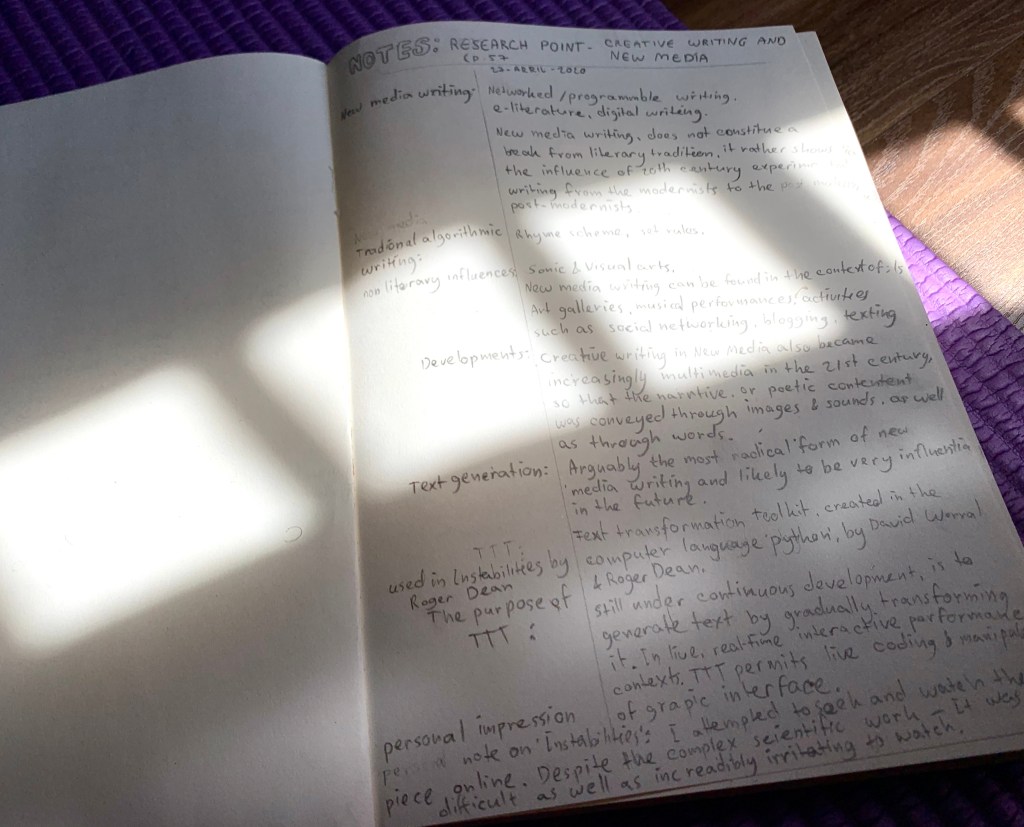
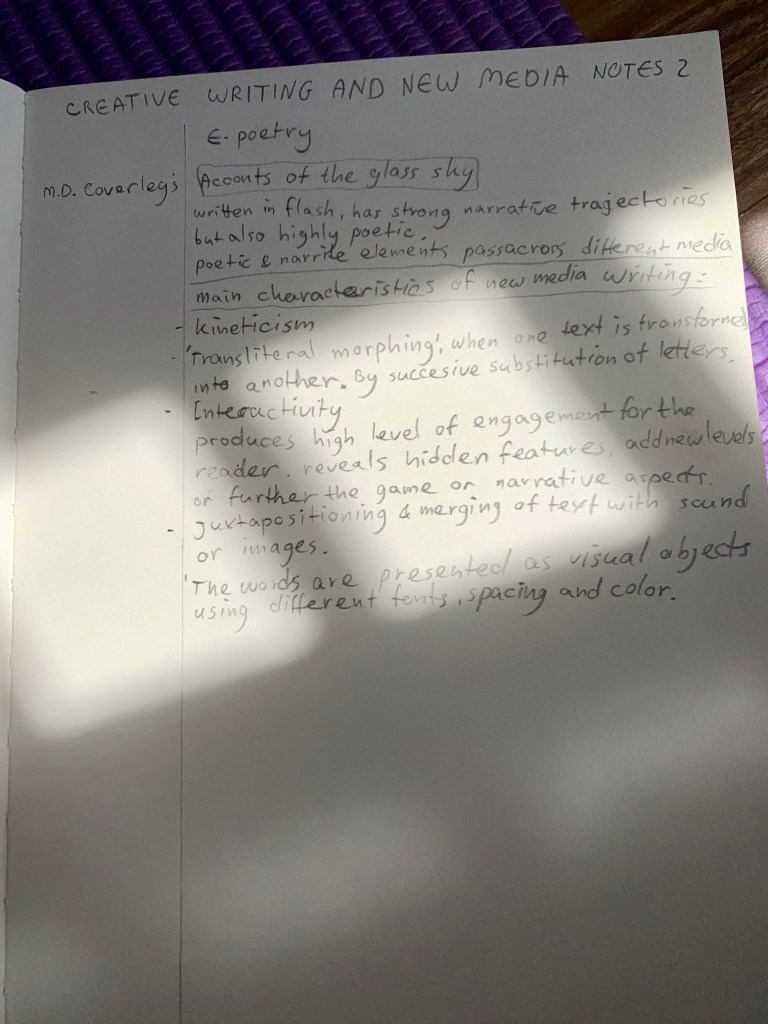
Notes on Hazel Smith’s essay, ‘Creative Writing and New Media’:
Exercise 2
What I’ve read – written – seen in the last 24 hours:
- Written notes & read course essay.
- Written multiple emails & exchange text messages with friends.
- Read a few pages of Orwell’s ‘1984’.
- Read multiple daily news articles ( recently too many due too Covid 19 ).
- Read educational materials with my children.
- Seen multiple social media videos ranging from news to comedy.
- Seen shows on Netflix ( The Last Kingdom ).
My short list most likely contains at least 50 – 100 different stories and communicative information pieces, written by journalists, scientists, educators, comedians, script writers, travel writers etc. Additionally, there is some oral and written story telling by friends and family.
Out of my multiple daily story encounters, there are many I consider art: Inspirational or creative social media posts and blogging, graphic contemporary art like MEMEs, political & social activism, scripts for film or TV programs, creative writing, Literature or poetry, storytelling and humor.
What I do not consider art: Quick functional texting or emailing. I guess email or text writing could be artistic and qualify, but it is borderline. The same goes for other practical information like train timetables, recipes etc.
Project 2: The hero’s journey
Exercise 1
I’ve Chosen to map the story line of one of my favorite childhood film productions ‘Labyrinth’:
Initial release: June 27, 1986 (USA)Director: Jim Henson Screenplay: Terry Jones Story by: Jim Henson, Dennis Lee.
Act I (Beginning = the hero’s decision to act): Teenager Sarah (Jennifer Connelly) is forced by her father (Christopher Malcolm) and her stepmother (Shelley Thompson) to babysit her baby brother Toby (Toby Froud) while they are outside home. Toby does not stop crying and Sarah wishes that her stepbrother be taken by the Goblin King Jareth (David Bowie).
Ordinary World: Sarah’s family home and ordinary teenage life.
Call to Adventure: Sarah is given thirteen hours to solve a labyrinth and rescue her baby brother Toby when her wish for him to be taken away is granted by the Goblin King Jareth.
Refusal of the Call: Sarah deeply regrets making her wish and begs the goblin king to return her brother.
Meeting with the Mentor: Sarah meets an ancient looking dwarf with a feisty attitude who showed her how to enter the Labyrinth. His name was Hoggle
Crossing the First Threshold: Sarah enters the dangerous labyrinth, starts the journey to the goblin city.
Act II (Middle = the action)
Tests, Allies, Enemies: Sarah meets numerous challenges, riddles and strange creatures. She also makes friends and finds travel companions. We learn that Hoggle, is actually Jared’s spy, sent to make sure she fails. He is torn between liking his new human friend and appeasing his master (the goblin king).
Approach to the Inmost Cave: Sarah and her companions approach goblin city and Jared’s castle.
Ordeal: Final encounter, facing the goblin king. Sarah finally breaks the spell, quoting lines from her story book. this ends with the movie’s most famous quote line: ‘You have no power over me’.
Reward: Baby brother Toby is freed and the goblin king is banished to live as an owl.
Act III (End = the consequences of action)
The Road Back: Sarah returns home and runs upstairs to ensure that her brother had been returned. She finds Toby sleeping soundly.
Resurrection: Sarah has had a good lesson, she gains responsibility, confidence and empowerment.
Return with the Elixir: Sarah and her her baby brother are home safely.
Original story script using the stages of the Hero’s Journey
For this exercise, I am using a children’s book idea I have, called ‘Practical Magic For Children’. It’s an empowerment story that teaches kids to cope with negative emotions using their imagination and colors. The hero of the story is actually the reader, the mentor is that part of the mind : The voice of inner happiness / wisdom. The Antagonists are negative and belittling emotions.
Act I (Beginning = the hero’s decision to act):
The Ordinary World: Normal every day life, home and school routine.
Call to Adventure: When kids face conflict and tough emotions, This little book can help find secret places, deep inside your mind. Whenever we visit, we find our hidden powers that can lift our spirit and make us feel stronger.
Refusal of the Call: Kids do not always believe in their powers, they might believe their too small.
Meeting with the Mentor: The mentor is called Ananda, Sanskrit word meaning “happiness, bliss”. He is a part of ourselves and is the wise voice or intuition, the keeps our mind happy and strong.
Crossing the First Threshold: The threshold is facing or coping with tough, scary situations.
Act II (Middle = the action)
Tests, Allies, Enemies: Bullying, fear, insecurities etc.
Approach to the Inmost Cave: The inner cave is a special mental state, where we teach kids to face their fears, believe in themselves and summon positivity through imagining colors and protective elements.
Ordeal: Facing different challenging situations & emotional storms.
Reward: Finding strength and power through learning mental exercises & positive imagination skills.
Act III (End = the consequences of action)
The Road Back: Continuing every day life with the new powers.
Return with the Elixir: Growing faith in ourselves and our ability to control our mind and emotion.
Further Reading
If you’re interested in finding out more about postmodernism, feel free to do your own research. Oxford University Press do an excellent series of ‘very short introductions’, including one on postmodernism (Butler, 2002), which you might also find useful for other parts of this course.
Exercise 2 – character archetype list
For this exercise, I’m including equivalent example character name from popular HBO fantasy – Game of Thrones
- The Protagonist / Hero – Main character who may fulfil a task or bring justice: House Stark members, Arya, Sansa, Bran and John Snow
- Antagonist – enemy or villain: House Lannister, mainly Cercei
- The Bully – Intimidates others: Joffrey Lannister ( Baratheon ), Ramsay Bolton
- The Creature of Nightmare – Threatens the hero’s life: The zombies behind the wall.
- The Damsel in Distress – The hero rescues her: Sansa Stark
- The Devil Figure – Tempts the hero: Pyter Baelish
- Dreamer – Wants to be something else:
- The Evil Genius – Seeks revenge and hates all: Pyter Baelish
- Friendly Beast – Assists the hero: Hodor
- The Initiates – Need training to become heroes: Arya Stark
- Martyr – Willing to die for a cause: The ‘Unsullied’
- Mentors – Train and counsel the initiates: Three-eyed Raven is Bran’s Mentor, Joqen H’hgar is Arya’s mentor.
- The Outcast – Exiled for a crime and becomes a wanderer: Bronn, The Hound
- The Star-Crossed Lovers – The pair usually meet tragedy: John Snow and Deanerys Targaryen
- Survivor – Never gives up and always pulls through: Tyrion Lannister, Jorah Mormont
- The Temptress – A beautiful woman who seduces the hero: Mellisandra
- Tyrant – Wants to be in charge: Joffrey Lannister ( Baratheon ), Ramsay Bolton
- Wizard – Has special powers: Brann Stark
Project 3 Ways of saying and seeing
Poetry and theme – Exercise 1
After reading the 3 given poems. I have decided that The Lost Land, By Eavan Boland, speaks about place in relation to identity and exile. There are poem lines indicating that it is written from longing in exile, Other lines speaks of leaving Ireland out of emergency or necessity rather than will:
‘I can see the shore of Dublin Bay.’
‘Shadows falling
On everything they had to leave?
And would love forever?’
‘I imagine myself
At the landward rail of that boat’
‘The Herefordshire Landscape’ by Elizabeth Barrett Browning purely evokes a sense of place in a nostalgic manner, without arousing negative emotions.. As its lovely lines are full of fine descriptions of local weather, plants, scenery & smells of an old familiar place, or possibly a childhood home?
‘Slough’ by John Betjeman, is full of social comment about progress and place. The poem lines indicate strong revolt and protest over the industrial takeover of Slough. Mentioning is it no longer fit for ordinary living to the point that the poet invites the bombs to destroy it. The mention of bombs as well as tinned food, provided a clue that this poem is possibly from the WW2 era. ‘Tinned minds, tinned breath.’ is possibly an expression of discontent over the war time manic public state. Which often suppresses personal freedoms in the name of emergency, or state cause.
Poetry, modernism and postmodernism
Branching out into different styles and expression forms seems a positive development to me. Just as in biological evolution, art & poetry continue to evolve too as new styles emerge. The art of poetry changes and gets reinvented with society. New forms, reflect cultural changes.
I believe it is healthy for rules to be questioned, stretched, challenged and re-tested. My personal taste in poetry is somewhere in the middle, I enjoy both modernist as well as post-modernist poetry and find expression in both forms: There’s great beauty & emotion in classic poetry, as well as power and expression in a spoken word performance or a good rap song.
Rap or Romantic?
• Her untimely exit from her, heavenly body – Rap
• Five miles meandering with a mazy motion – Romantic
• Victims of wordly ways, memories stays engraved – Rap
• A dead bird flying through a broken sky – Romantic ( I got the wrong answer – Rap can be very romantic )
• Drive my dead thoughts over the universe – Romantic
A rough guide to poetic devices – Exercise 2
Poetic devices examples I found in other poems:
Rhyme
Words that sound alike, usually at line endings.
Example found in another poem:
Some say the world will end in fire;
Some say in ice.
From what I’ve tasted of desire
I hold with those who favor fire.
But if it had to perish twice,
I think I know enough of hate
To know that for destruction ice
Is also great
And would suffice.
(Fire And Ice – by Robert Frost)
Source: http://www.poetry.org/frost.htm
My own example:
Outside my window, sweet savior stands.
Playful sunbeams stroke leafy strands
In fickle times, all paths refute.
I’m holding on to mango roots.
Rhythm
A metered structure of syllables, consonants, breathing, or pauses.
Example found in another poem:
How do I love thee? Let me count the ways.
I love thee to the depth and breadth and height
My soul can reach, when feeling out of sight
For the ends of Being and ideal Grace.
I love thee to the level of every day’s
Most quiet need, by sun and candlelight.
(How Do I love Thee by Elizabeth Barrett Browning)Source: http://www.poetry.org/browning.htm
My own example:
Mango rain, when will you return? Come now – hard & heavy.
Wash away the dust from my soul. Quench me, cool me, soak me.
Turn me into your river and let all things flow.
Repetition:
Intentional repetition for reinforcement and effect.
To the swinging and the ringing
Of the bells, bells, bells,
Of the bells, bells, bells,bells,
Bells, bells, bells
To the rhyming and the chiming of the bells!
(from The Bells by Edgar Allan Poe) Source: http://www.poetry.org/poe.htm
My own example:
It’s raining, raining, raining, raining, but never ever snows.
The honest rain, where true illusion grows.
Alliteration
Two or more words in a line of poetry that begin with the same initial sound.
and watched as they burnt to ashes, watched
and worked on his whiskey, working hard.
( from: Nowhere to Nowhere, BY BJ OMANSON) Source: https://www.poetryfoundation.org/poems/153611/nowhere-to-nowhere
Assonance
Repeating vowel sounds without repeating consonants. In poetry, often used as an alternative to rhyme.
My brother is dying and I am not.
I drag him behind me like a spiritless balloon, like the first robot,
like the last clown-car clown, his ridiculous Fiat, his lot
to be crushed, left for dead, covered in snot,
his puffy hands, his outsized shoes, his flower pot,
like Virgil Earp, Clanton-ganged, at the Not
OK Corral, un-brothered, gutshot,
like the night without sleep in Turandot.
(from Forget-Me-Not by John Hodgen) Source: https://www.poetryfoundation.org/poetrymagazine/poems/89337/forget-me-not
Consonance
Repeating consonants without repeating vowels. Consonance gives melody to verse.
my single acre, to be safe, to be still
and watch the planet’s purposeful turning
behind a cairn of roughly balanced stones.
Uprooted, scarred, weather-gray of bones,
I love their old smell, the familiar unknown.
To be sure this time I know where I belong
I have brought, at last, the vagrant road home.
(Scavenging The Wall by R. T. SMITH)Source:https://www.poetryfoundation.org/poetrymagazine/poems/41081/scavenging-the-wall
Onomatopoeia
A word that imitates the sound made by the thing being described.
When a poem is born What is the chance Of words in rain Drip drop dance Ping ting sing Pitter patter rhyme Rain dance acceleration Makes my poem climb
(from Rain Dance Poem by Victoria Reome) source: https://www.poetrysoup.com/poem/rain_dance_poem_782877
Personification
Ascribing human qualities to an object.
It is sticking out of the ground with my well rounded head. I am crazy in love with the soil, but will be eager to be plucked For I know someone will exclaim with delight at my crooked prettiness.
(from Call Me Miss Carrot by Karen Krutsinger) Source: https://www.poetrysoup.com/poem/call_me_miss_carrot_1252503
Simile
A figure of speech in which an image is evoked by likening one thing to another.
Here in the electric dusk your naked lover
tips the glass high and the ice cubes fall against her teeth.
It’s beautiful Susan, her hair sticky with gin,
(from Heat by Denis Johnson) Source: https://www.poetryfoundation.org/poems/143780/heat-597917a1f0de8
Metaphor
To describe something by giving it the identity of something else.
A
i have found what you are like
the rain,

        (Who feathers frightened fields
with the superior dust-of-sleep. wields
(I have found what you are like – by e e cummings)
Imagery
Use of devices such as simile and metaphor to create images in the reader’s mind.
Hold fast to dreams
For if dreams die
Life is a broken-winged bird
That cannot fly.
from Dream by Langston Hughes
Poetic devices found in chapter 1 of ‘Sputnic Sweetheart’ by Haruki Murakami ( first published by Kodansha Ltd, 1999 )
‘In the spring of her twenty-second year, Sumire fell in love for the first time in her life. An intense love, a veritable tornado sweeping across the plains – flattening everything its path, tossing things up in the air, ripping them to shreds crushing them to bits.’
This is the very first paragraph in the novel. It includes sweeping combination of metaphor and simile, describing love as as a destructive tornado. This passionate metaphor in the very first sentence of the book, allows the reader to immediately emotionally connect with, and become intrigued / curious by the story and lead character.
‘Her resolve was a Regular Rock of Gibraltar’
This sentence utilities alliteration, which emphasizes the descriptive meaning.
‘It made her think of Laika, the dog. The man-made satellite, streaking soundlessly through space. The dark lustrous eyes of the dog gazing out of the tiny window. In the infinite loneliness of space, what could Laika possibly be looking at ?’
This paragraph utilizes imagery in order to send the readers on a sad contemplation of Laika the Soviet space dog.
Close Reading
exercise 3 Fern Hill
The poem shifts between poetic description of a joyful country childhood or youth, with dark metaphors on man’s fundamental enslavement to time. There’s a strong contrast between the light and dark moods. Here are some example line of the contradiction :
‘All the sun long it was running, it was lovely, the hay youth, to dark Fields high as the house the tunes from the chimneys, it was air’ moods. And playing, lovely and watery’.
‘Time let me play and be Golden in the mercy of his means’ ‘Time held me green and dying Though I sang in my chains like the sea’
I recognized several poetic devices, used in order to support line structure, harmony and general atmosphere. here are some examples devices with corresponding lines:
Rhythm: ‘With the dew, come back, the cock on his shoulder: it was all’, Alliteration: ‘And green and golden I was huntsman and herdsman, the calves’ Assonance: ‘Time let me hail and climb’ Consonance: ‘About the lilting house and happy as the grass was green’ Simile: ‘And fire as green as grass’, Imagery and Metaphor: ‘As I rode off to sleep the owls were bearing the farm away, And all the moon long I heard, blessed among stables, the nightjars, Flying with the ricks, and the horses, Flashing into the dark’.
Personification is used as a way to support the theme of time – We can find personification of time itself in various lines throughout the poem: ‘Time let me hail and climb, Time let me play and be, I should hear him flying over the fields, time held me green and dying’,
The poem itself seems to focus on human relevance to time throughout different stages of human lives. How oblivious and ambivalent towards time we are throughout our youths, waking up to realize how precious our time was as our life extends and our time runs out. The farm, is a metaphor of a place we all long for in our past. Additional themes besides time and place are childhood and nostalgia.
There are several lines that particularly appeal to me, the following lines depict the banality of life swayed by the forces of time: In the sun born over and over,
I ran my heedless ways,
My wishes raced through the house high hay
And nothing I cared, at my sky blue trades, that time allows
In all his tuneful turning so few and such morning songs
These lines remind me of my own childhood, looking back on how time seems different to the young, who only wish for it to pass quickly before realizing how precious time and vitality is, later on in life. The poem draws an image and memory of sunny childhood memories that only exist in each of our souls. A yearning for past places, warm and young.
The poem’s rhythm, flatmates between choppy to flowing, which goes back to the contrast between the light and dark moods. It seems choppy in parts, like the voice of an older person while flowing in the parts describing images from the farm, childhood and youth.
The speaker seems to be a person looking back on his life and examining his relation to time. View seem to be emotional yet inferred of opinion.
I noted the recurring reference to light and the sun. While the farm seems to be representing the theme of place. I cannot interoperate the exact meaning of light / sun.
 Creative Arts Today