Introduction exercise:
Reasons people read:
- To learn or seek information such as news stories, instructions etc.
- For leisure and entertainment.
- Poetic inspiration and literature appreciation.
Reasons people write:
- To share / spread practical information.
- Teach and develop teaching materials
- Share Stories & inspire others.
- Literature or poetry passion.
Exercise 1
When a story sees print. It is, in a sense, ‘born’ or ‘unleashed’ onto the world. From that moment, it starts a life of it’s own. Separate from it’s source. There’s no telling who would read it, be affected by it and in which way.
Stories or texts can easily become misused, appropriated, or misunderstood. Although there are copyright laws, it is very difficult to trace all users in our global / digital age. Texts can be endorsed or disapproved by the audience. Which in turn would probably personally affect the source, as well as inspire more related texts, reviews etc.
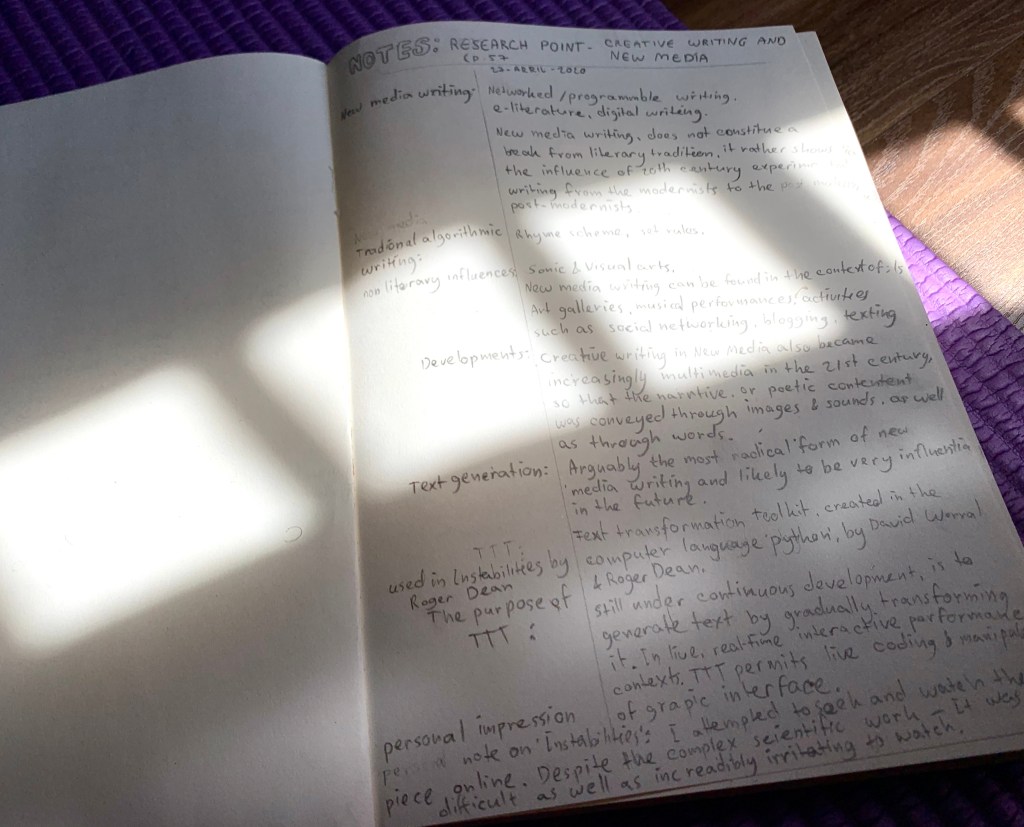
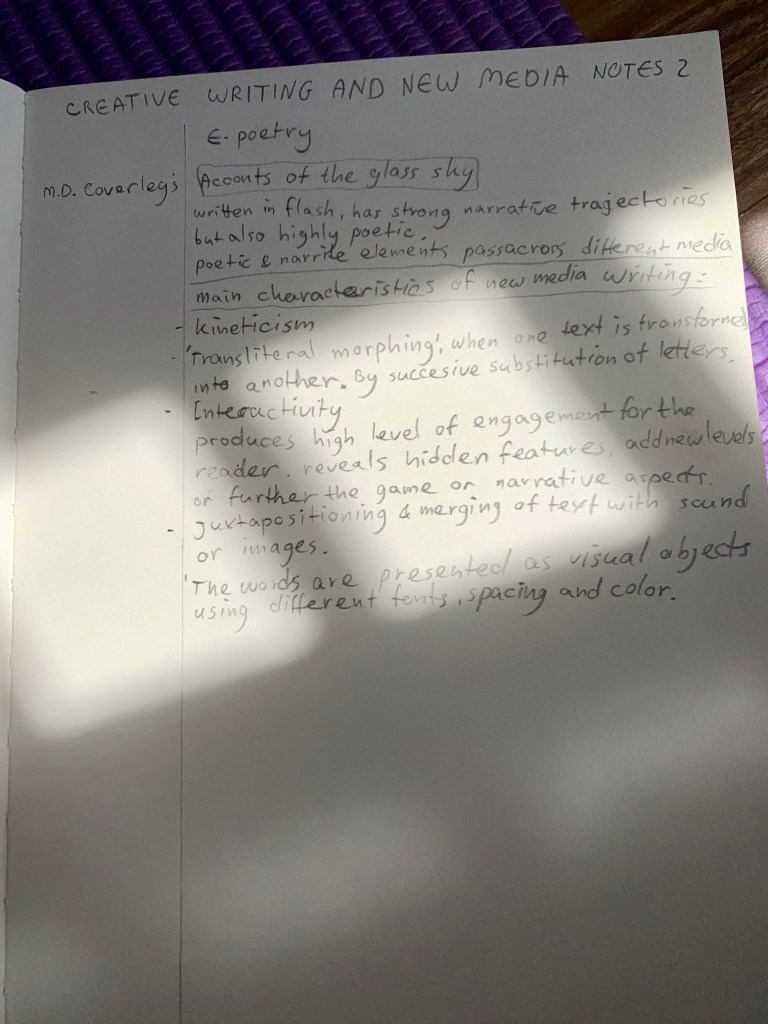
Notes on Hazel Smith’s essay, ‘Creative Writing and New Media’:
Exercise 2
What I’ve read – written – seen in the last 24 hours:
- Written notes & read course essay.
- Written multiple emails & exchange text messages with friends.
- Read a few pages of Orwell’s ‘1984’.
- Read multiple daily news articles ( recently too many due too Covid 19 ).
- Read educational materials with my children.
- Seen multiple social media videos ranging from news to comedy.
- Seen shows on Netflix ( The Last Kingdom ).
My short list most likely contains at least 50 – 100 different stories and communicative information pieces, written by journalists, scientists, educators, comedians, script writers, travel writers etc. Additionally, there is some oral and written story telling by friends and family.
Out of my multiple daily story encounters, there are many I consider art: Inspirational or creative social media posts and blogging, graphic contemporary art like MEMEs, political & social activism, scripts for film or TV programs, creative writing, Literature or poetry, storytelling and humor.
What I do not consider art: Functional, brief texting or emailing. I guess email or text writing could be graphic or contain artistic language style, therefore qualify as art, but it is borderline. The same goes for other practical information like train timetables, recipes etc.
 Creative Arts Today