Semiotics Research point
Semiotics is the study of how signs are constructed and interpreted. It’s something you’ll come back to again and again as you pursue your studies in the creative arts.
Sign = Signifier + Signified
Essentially a sign is composed of a signifier – the form the sign takes – and the signified, the concept to which it refers or represents.
For example, a crown is a signifier of royalty, power or heritage (the signified). Signs operate within systems of other signs that give them value and meaning, so the crown might be seen in contrast to a baseball cap, bowler hat or other signs representing headwear and the relative status associated with them.

The image: In the photo indicated, I observe the geometric crop circle created by Rod Dickinson, along with Silberry Hill, a a 4700-year-old Neolithic site of both sacred mysticism as well as scientific interest.
I feel that the signifier in the photo is within the connection between these two human creations: the old, the new, the sacred and the lush green landscape – or place they stand upon.
My conclusion is that the crop circle in the field besides the sacred hill are the signifiers of English heritage, history & natural cycle of the land are signified. This makes the photo a sign of the continuity of harvesting, which represent a tradition or connection between the land and its people.
Research notes – The history and meaning of crop circles:
- “Michael Dames has put forward a composite theory of seasonal rituals, in an attempt to explain the purpose of Silbury Hill and its associated sites: (West Kennet Long Barrow, the Avebury henge, The Sanctuary and Windmill Hill), from which the summit of Silbury Hill is visible”.
- Crop circles of various geometric designs and sizes have been appearing overnight since the 1970s, mostly in the United Kingdom, but also across Europe, the USA and Australia. “Circles in the United Kingdom are not distributed randomly across the landscape but appear near roads, areas of medium to dense population and cultural heritage monuments, such as Stonehenge or Avebury”
- The phenomenon was quickly adopted by fringe theorists as linked to paranormal events and extraterrestrial activity sightings for the circles are created to be viewed from the air, by aliens, or the gods perhaps.
- The number of crop circles increased along with media coverage, conspiracy theories and public attention.
- During the 1990s, creators such as Dave Chorley, from Winchester in Hampshire, and his friend Doug Bower, have come forward and confessed to have created mysterious crop circles over years as a public hoax. Today, crop circles are no longer a mainstream popular conspiracy theory, but are mainly considered to be a folk art form, like Chorley’s son quotes for a BBC interview: “Mandalas drawn on the world’s biggest Canvas”.
- It was initially thought that crop circles shapes are too perfect to be man made, yet the perfectly straight lines that crop machinery leaves, can be used for geometrical alignment, resulting in perfect format.
- Sacred geometric art designs are can be found across multiple religions and cultures: Mandala paintings and sand Mandalas in Hinduism and Buddhism, geometric decorative design and architecture in Islam. The Silbury Hill crop circle format is reminiscent to a star of David design, made of 2 overlapping triangles.
- A full crop circle archive, showing details like the dates, location and pattern is available online. I noted that designs in the 70s began simple, becoming more complex as the craft developed. Some are ”wonky” or failed geometric attempts, while some involve popular, or meaningful signs for example: the extinction rebellion logo crop circle – it is even possible to order a custom crop circle through their website.
Research and reference links:
Silbury Hill 2021, Wikipedia [online], available at: https://en.wikipedia.org/wiki/Silbury_Hill, accessed 20/5/20
Glickman Michael, updated 2021, Crop circle center archive, available at: :https://www.cropcirclecenter.com/date/2020/202007.html accessed 20/5/20
Radford Benjamin 10/06/2017, The Crop Circle Mystery: A Closer Look, Live Science Contributor Article [online], available at: https://www.livescience.com/26540-crop-circles.html accessed 20/5/20
Marks Simon, Crop circle ‘inventor’s’ son talks about father’s legacy, [BBC film] available at: https://www.bbc.com/news/av/uk-england-hampshire-49608647 accessed 20/5/20
Crop circle 2021, Wikipedia [online], available at: https://en.wikipedia.org/wiki/Silbury_Hill, accessed 20/5/20
Exercise 1: What does this apple mean?
Research notes:
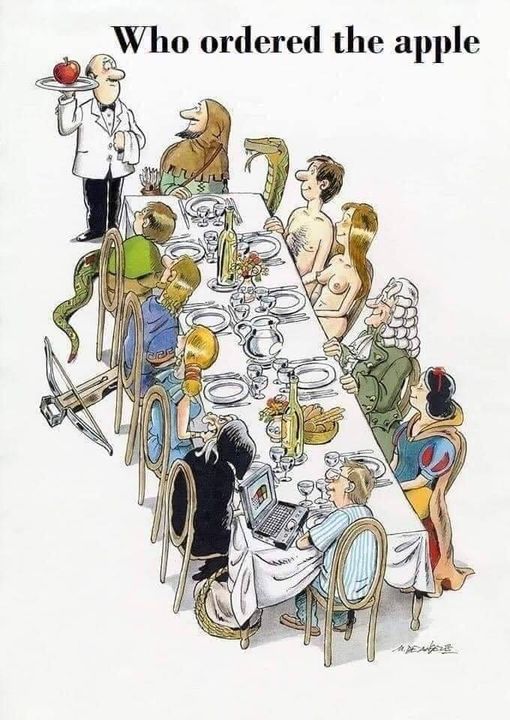
Marco de Angelis, “Who ordered the apple?” available on https://www.cartooningforpeace.org/en/dessinateurs/marco-de-angelis/ accessed accessed 22/5/2020
“Apples can be easily called a “double-faced” and eternal symbol. For many centuries, they have been representing both good and evil, passing through all the nuances of other meanings, depending on the era and the accepted world view.” (O. Karseko 2017)
The main problem of identifying the meaning of the word: ‘apple’ is that as late as the 17th century, the word “apple” was used as a generic term for all (foreign) fruit. In some languages, oranges are called “golden apples” or “Chinese apples”. Datura is called “thorn-apple”. When tomatoes were introduced into Europe, they were called “love apples”. Potatoes are called (lit “earth-apples”), in French, Dutch, Hebrew, Afrikaans, Persian and Swiss German.” “The classical Greek word μήλον (mēlon), or dialectal μᾶλον (mālon), now a loanword in English as melon, meant tree fruit in general, but was borrowed into Latin as mālum, meaning ‘apple’. The similarity of this word to Latin mălum, meaning ‘evil’, may also have influenced the apple’s becoming interpreted as the biblical “forbidden fruit” in the commonly used Latin translation called “Vulgate””.
( Apple (symbolism) Wikipedia 2021)
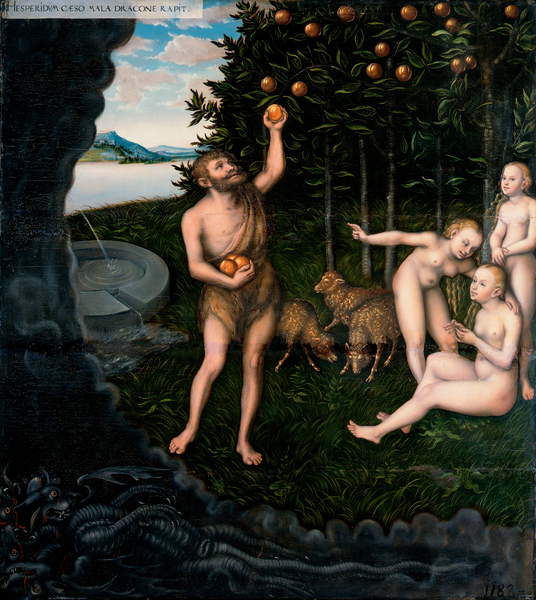
Cranach, Lucas, the Elder (1472-1553)
Location: Herzog Anton Ulrich Museum, Braunschweig, Germany, available at: https://www.bridgemaneducation.com/ accessed 22/5/2020
Through brief research, we learn that an apple “is a complex symbol, with a variety of meanings and incorporated in a variety of contexts.” (http://umich.edu symbolism project 2021) “Apples appear in many religious traditions: though the forbidden fruit in the Book of Genesis is not identified, popular Christian tradition holds that Adam and Eve ate an apple from the forbidden tree in the Garden of Eden. The unnamed fruit of Eden thus became an apple under the influence of the story of Hercules and the golden apples in the Garden of Hesperides, As a result, the apple became a symbol for knowledge, immortality, temptation, the fall of man and sin.” ( Apple (symbolism) Wikipedia 2021)
It can mean love, knowledge, wisdom, joy, death, and/or luxury. The apple could be an erotic / sensual association with a woman’s breast with the core sliced in half representing the vulva. The apple of the Garden of Eden, is the symbol of temptation, evil and of original sin. In secular terms, the apple functions as a symbol for the cosmos or totality, due to its nearly perfect spherical shape.”
Gertrude Jobes, Dictionary of Mythology, Folklore, and Symbols
Screcrow Press, Inc., New York, 1962, Part I, pp. 112-114 [GR35.J6.v.1(IC)]
The perfect beauty, the witch and the apple:

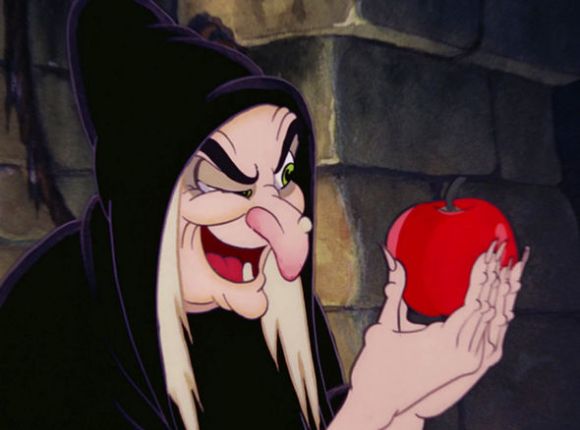
In the images above: we see a similar, rosy apple as two opposing signs or symbols.
Top right image: Evil witch in hag disguise, Walt Disney, Snow White (1937 film), available at: https://youtu.be/cB7O_JIxGuY accessed 22/5/2020
Dante Rossi’s Venus Verticordia (1864-1868), meaning ‘Venus, Changer of the heart’. The apple along with roses and honeysuckles signify erotic context : irresistible beauty, sensuality, perfection and youth are signified. This image is a sign of female fertility, sexuality and love. The arrow signifies Cupid, or love. The golden halo The golden apple refers to Greek mythology, as the prize won by Venus (Aphrodite) in a beauty contest referred to as the Judgement of Paris. The color rose: the fruit, the flower, the lips, the cheeks and nipple, signifies fertilely. Venus’s golden halo represents someone pure and godly.
In the second images, the same rosy apple imagery is a sign of evil treachery and deceit. The old hag, or wicked queen signify jealous rage and envy as well as conspiracies to harm innocent. This connects to again to Christian folklore, in which the apple symbolizes a tool of delivering evil, sin or death. A connection might have been made due to the Latin word for ‘apple’ (“melum”) and ‘evil’ (“m?lum”) sounding similar. It is also the place to note early Christians saw the bulge in a man’s throat linked to the forbidden fruit stuck in Adam’s throat – hence in became, “Adam’s apple”.
Apple thieves, patriarchy and biblical misogyny:
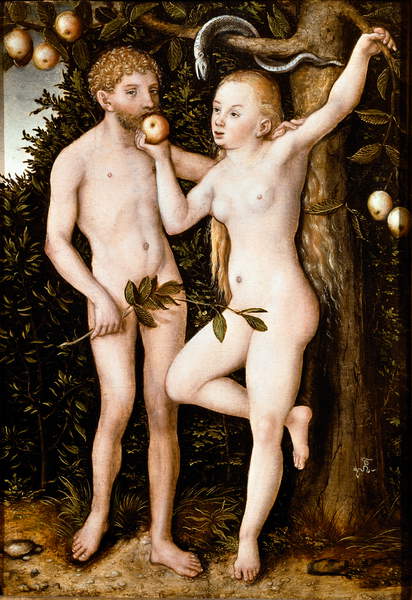
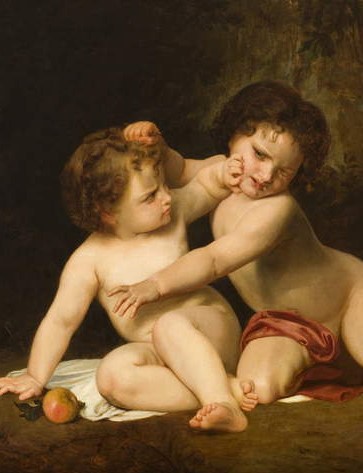
Right image: William Adolphe Bouguereau, 1877-89, ‘War (The First Discord)’, (oil on canvas) CreatorEvans, De Scott (1847-98) Available at: Brigman Images, accessed 22/5/2020
Comparing the stories of Hercules ( stealing the golden apple) to Biblical Eve (the forbidden fruit), both stories take place in a similar place which is a magical garden, or Eden. However, we find jarring asymmetry: Hercules is rewarded with immortality and wisdom and marked as a mythological hero, while poor Eve gets scolded by god, takes the blame and gets banished from Eden. Women are still seen responsible for men’s failure and seduction, a common blame shifting for man’s own temptation, possessiveness and inability to self regulate, especially in cultures who suppress and fear female sexuality. I have chosen to place two images together, in order to question and challenge the biblical misogyny against Eve while suggesting a more probable scenario. For in reality, it is generally men who are usually the cunning or aggressive.
In the first image, we see the classic, beautiful Eve tempting Adam and actually feeding him the forbidden fruit, as the serpent (signifier of evil and sin ) hangs overhead, whispering and guiding her. It is probably the most notable Judo-Christian sign of female association with evil and temptation. The woman and the fruit signify temptation and sexuality, or man’s inability to resist temptation.
The second image: War (The First Discord) isn’t directly connected to the biblical story, yet to me it seems to represent a far more realistic imagery of Adam and Eve, as two children in the garden of Eden, fighting over the apple. Adam isn’t innocent as the bible indicates, he’s perfectly aggressive and actually snatches the forbidden fruit for himself.
Godly expectation Vs Human imperfection
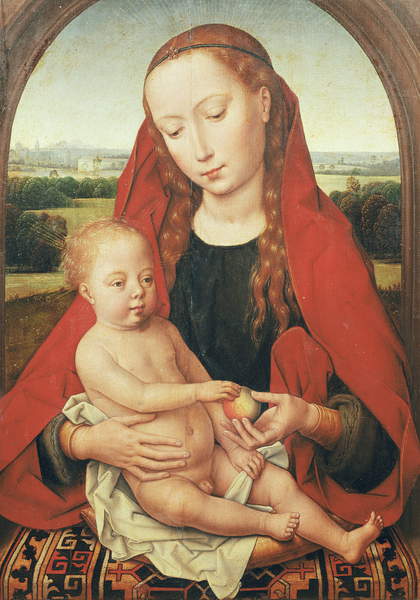
Apples are found in multiple depictions of mother Marie and baby Jesus. In this context, the mother, child and the apple signify wisdom and ultimate purity while and these paintings are signs of Devine or godly perfection.
I chose “The son of man”, Magritte’s most famous painting, to answer “Virgin and Child”s impossibly high moral expectations with a sign of man’s perfect imperfection. The well dressed man, signifies human sophistication and achievements while the apple obscuring man’s vision signifies once again, eternal temptations or sin. The green color could signify money or greed. As the piece is assumed to be a self portrait, this may indicate self reflection or criticism.
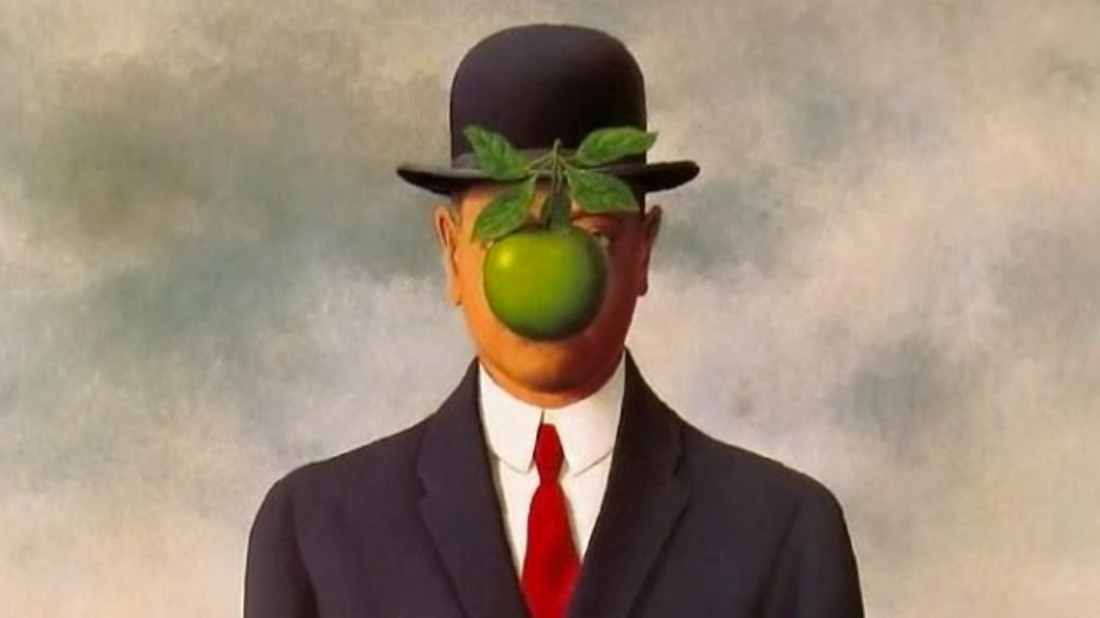
Right: René Magritte 1964, ‘The Son of Man‘, Available at: Brigman Images, accessed 22/5/2020
Apple – design ingenuity turned corporate

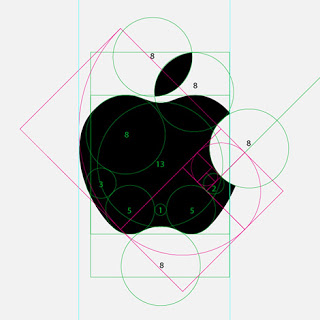

Middle: Apple logo as a sign of design perfection
Right: “Paradosso del capitalismo”, Daniele Siviero, Available on: Pinterest.com accessed 22/5/2020
When thinking Apples signs, we must of course mention and discuss Apple and their famous bitten apple logo. The apple in the logo was meant evoke biblical mythology as a sign for wisdom, which included labeling the person who took the bite (Adam ? or potential clients?) as superiorly smart and efficient. This reflects well in the company’s early ad campaigns, which bluntly included “smart Apple” folks down talking “daft PC” folks. “The Apple logo symbolizes our use of their computers to obtain knowledge and, ideally, enlighten the human race)”.
The modern apple logo is additionally connected to apple as a sign of appealing visual beauty and functional perfection, this evokes the connotation of the sign “apple” with both Venus and immortality. the “Golden ratio” was considered in creating Apple logo, as well as other apple icons, such as Icloud.
I have chosen to include a third image: “Paradosso del capitalismo” or Paradise of Capitalism by illustrator Daniele Siviero. The image shows a thin child signifying starvation, while the apple logo signifies giant corporations and their uselessness when it comes to social equality issues, a sign of capitalist injustice.
Conclusion:
Apple semiotic research shows multiple, signs or symbols. The meaning changes according to to artwork type and setting, especial important is who is holding the apple. The following table summarizes common recurring symbolism.
| Apple with | Common signified |
| man | Knowledge, wisdom, temptation, sin |
| young women | Temptation, sin, lust, love, beauty, fertility |
| old woman | Evil plotting, poverty, death |
| Baby or Jesus | Purity, perfection |
| Still life / vanitas | Pleasures of life, death |
| Modern design context | Wisdom, superiority |
Research reading and references:
Apple (symbolism) Wikipedia 2021, Available on: https://en.m.wikipedia.org/wiki/Apple_(symbolism) accessed 22/5/2020
Oksana Karseko 2017, ‘Apple symbolism in art, A healthy temptation‘, Encyclopedia Art [website], available on: https://arthive.com/encyclopedia accessed 22/5/2020
Peter Y. Chou 2009, Apple Symbolism, WisdomPortal.com [online] available on: http://www.wisdomportal.com/Poems2010/AppleSymbolism.html accessed 22/5/2020
Redding, Dan 25/01/2018, ‘What Does The Apple Logo Mean?’ Culture creature [online], available at: https://www.culturecreature.com/apple-logo-meaning accessed accessed 22/5/2020
The Son of Man, Wikipedia 2021, Available on : https://en.wikipedia.org/wiki/Venus_Verticordia_(painting) accessed 22/5/2020
Venus Verticordia (painting), Wikipedia 2021, Available on : https://en.wikipedia.org/wiki/Venus_Verticordia_(painting) accessed 22/5/2020
Denotation and connotation

‘… and the Manager wants to try me in a different position each day’ 
‘Ah, Mr. Mactavish, I see you have some ginger nuts’ 
‘I wish I could see my little willy’
Exercise 2: Join the Navy

Denotation: I can see a man who seems young and fit. He’s wearing a navy uniform and cap. He’s riding a giant golden torpedo missile, splashing in the water while he’s holding whip and reins as if he was riding a toy horse. The slogan font is large, clear and spaced, the colors are red, blue and white, which associates with British or America flag colors.
Suggested connotation: It is clear the man seems to be enjoying himself. His appearance and facial expression is of a young boy having the time of his life during some kind of dangerous play. I can assume this is intended as a message to future recruits that boys have fun while being brave in the navy. The shape and size of the missile are unmistakably phallic, the splashes of water around it immediately associate with male pleasure and orgasm. I believe this couldn’t have been unintentional as it’s the most obvious element in the image and impossible to miss. This poster basically indicated a bluntly that there’s plenty of “action” in the navy. As we all know, sex had always been a corner stone in advertisement. Additionally, something about the man’s facial features and the way he fits his uniform perfectly, might have queer indication, but this is a rather subtle suggestion, not a direct message.

Denotation: A dominantly red poster, four red lip sticks and a clear header saying: ‘This is an ad for men’. In the fine print, we find a message, informing ‘men’ of an average 15% increase in profitability found in businesses who had more female leadership. At the bottom of the image, we find the LÓreal logo, followed by reference to the research source.
Suggested connotation: The idea for the poster is similar to The color and elements of the image obviously signify the feminine, yet the meaning of the text is: ‘an ad for men’. This contradiction, creates a clever paradox that triggers curiosity and hooks potential viewers to read more and find that when women occupy 30% of management positions for instance profitability was found to increase by 15%.. Although the main message is indeed addressed to men, this poster is definitely has a more powerful sign or meaning for women, LÓreal’s traditional sales market – showing them the company invests in advertising women’s rights. This is not exactly charitable, as it aspires to creates a positive public image of the brand, which is likely to drive sales.
 Creative Arts Today