Research point: But is it art?
Our research read describes the scientific genius process of relentless cycle of trial – error – conclusion – modification. With emphasis on the importance of independent experimentation – “This fact showed me how little dependence was to be placed on the statements of chemical writers in regard to this particular subject, and how necessary it was to trust to nothing but actual experiment”.
Do you see photography as mechanical or creative? Can any process be both?
I believe all arts involve both a mechanical, technical or scientific aspects within the creative process. If we observe traditional art forms, painting for example, we find very technical and scientific processes used such as canvas preparation, perspective measurements and color mixing. Photography can certainly quality as creative, due to the fact that ideas for photos start in the creative mind, creative vision or “the good eye” in photography the subject, atmosphere, light and position.
Photography requires dedication and expertise in camera use, a photo is essentially the transferring and preserving images that inspire us using light and film. Although we use a camera, the process is not completely different from painting and image using our brain and hands, both processes start in the mind, despite photography tools being slightly more ‘technological’ in nature.
Exercise 1
Photography is a unique art form due to the following points:
Firstly, as previously mentioned, photography is fairly modern in comparison with other art forms that have been evolving over thousands of years. As concluded by Talbot’s manuscript, the initial development of photography was scientific and experimental.
Photography is the first art form requiring a mechanical devices, despite being quite a relatively new form, it is one of the fastest forms to evolve and change due to to technological advances and new types of cameras being invented.
Unlike other art works, a photo is relatively mass produced in print and digitally. Photographs can transcend us through time and transport us to places and specific events regardless whether we view the original or not. This is the reason became an important part of the storytelling process, this is especially central to journalism and mass media.
Research point
Notes on ‘Context as a Determinant of Photographic Meaning’
- Photographs are recontextualised through shift in location, as the context changes, so does the meaning.
- Most critical analyses of photographs concentrate on their immanent structure, their internal relations (part to part, parts to whole within the framing edge).
- The frame of the photograph encloses a space, a world, which we can enter (in our imaginations).
- although our attention is primarily directed towards the image, we always retain a subsidiary awareness of its/our environment. No figure can be perceived except in relation to a ground.
- the word ‘context’: several different types of possible context is being referred to, contexts can be architectural, media, mental, socio-historical.
- In most cases, context shift is a change of emphasis in the photograph’s depicted content: different parts or characteristics of the image appear important in different display contexts. Alternatively, its whole meaning is given a new significance, is enhanced or modified.
- when a photograph enters into a montage relationship with either a caption, text, another picture, a ‘third-effect’ meaning can be generated from that juxtaposition.
- In the distant past, paintings and sculptures were produced for specific locations, as the mobility of artworks increased until they lost all connection with specific places.
- geographic dispersal and mobility was extended by the development of various kinds of reproductive processes, culminating in the invention of photography. There is a need to examine the life of an image as well as its birth, to consider its circulation, its currency, as it moves through time and space from context to context,
- Jo Spence – Beyond the Family Album, Private Images, Public Conventions, depicting Jo Spence from the age of eight-and-a-half months to her forties was displayed in the ‘Feminism and Photography’ section of the Three Perspectives on Photography exhibition at the Hayward Gallery, London. Spence’s photographs explicitly challenge context conventions by transposing images which are normally found only in family albums (the private realm) into the public sphere.
- If display context can influence the meaning of a photograph, the photograph can influence the meaning of the context. Beside the display and media contexts in which photos appear, we must also take into account what Ernst Gombrich calls ‘the beholder’s share’. A viewer approaches an image not with a blank mind but with a mind already primed with memories, knowledge, prejudices; there is a mental set or context to be taken into account.
- Although ‘everyone is different, a unique individual, therefore every person’s response to an image is different and exclusive to them’. The mass media would simply find communication impossible if there were not common desires, experiences and values to appeal to and to work upon. Pictorial stereotypes do not merely exist externally in the world of the mass media, they inhabit us.
Exercise 2 – “artistic” photo
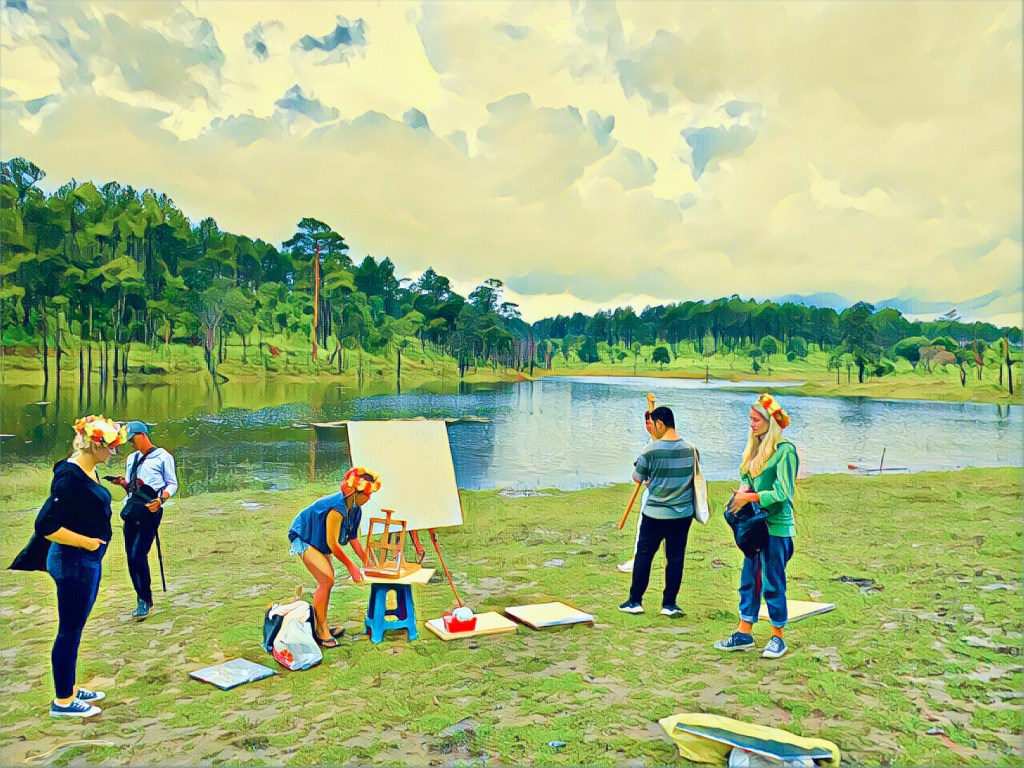
I’ve chosen a private photograph from my own collection. I consider the photo artistic as the image reminds me of Georges Seurat’s famous work: ‘A Sunday Afternoon on the Island of La Grande Jatte’. Additionally it was taken under special circumstances, at a fantastic location: The photo was taken on the Phnom Penh arts community painting day trip to Kirirom national park. We were all painting by a beautiful lakeside on an overcast day, with flower crowns in our hair. The scene inspired me to take some photos for the purpose of possibly creating either paintings or artistic photos later on. The photo series itself is beautiful, I’ve rendered some of them using color enhancements and special art filters.
Research point – The Flood
Examples of my own use of photography in social media:
I’m rather aware of my privacy and problems in social media use. My contact list is limited to people I know in person and wish to stay in touch with. However, living abroad, I do use these networks in order to keep in touch with family and friends, I occasionally share photos, especially of my children during holidays and special family occasion and friends on Facebook.
Additionally, I love travel aesthetic and natural photography, there are really nice groups to be a part of and I do rarely share a photo on Instagram, which is a more focused on photography and artistic shots.
Another personal use of photography on social media is for business, promotional travel photos are great for business and developing a client network.
On social media, I do try to share only photos of quality and value. Party selfies usually get privately sent and deleted shortly afterwards.
believe the internet is indeed like an ocean, or flood of information and resources. This is probably unstoppable in the near future, the data will only keep increasing in our digital age, therefore we need the solution is in learning how to swim, or maneuver within the flood, become smarter and more selective in focus and our ability of detecting quality resources, including images and photographs,
The vast abundance of photographs available on social media had probably democratized photography, for the reason that it created a vast new stage for photographs to be displayed and make an impact. This is especially true for pictures taken by rural populations, indigenous people and refugees. Social media is one of the only stages for their images and voices to reach the world. I must add that social media changes recently, it isn’t as free as it used to be and seems more commercially motivated as well as censored by authoritarian orders. Arrests due to social media images or posts are becoming a new norm in many countries.
The Work of Art in the Age of Mechanical Reproduction (1935/1936) – Walter Benjamin available at : https://www.jahsonic.com/WAAMR.html accesed 1/7/2020
Reading notes:
These convergent endeavours made predictable a situation which Paul Valéry pointed up in this sentence: ‘Just as water, gas, and electricity are brought into our houses from far off to satisfy our needs in response to a minimal effort, so we shall be supplied with visual or auditory images, which will appear and disappear at a simple movement of the hand, hardly more than a sign.
“One might generalize by saying: the technique of reproduction detaches the reproduced object from the domain of tradition. By making many reproductions it substitutes a plurality of copies for a unique existence. And in permitting the reproduction to meet the beholder or listener in his own particular situation, it reactivates the object reproduced. These two processes lead to a tremendous shattering of tradition which is the obverse of the contemporary crisis and renewal of mankind. Both processes are intimately connected with the contemporary mass movements. Their most powerful agent is the film. Its social significance, particularly in its most positive form, is inconceivable without its destructive, cathartic aspect, that is, the liquidation of the traditional value of the cultural heritage.”
“Unmistakably, reproduction as offered by picture magazines and newsreels differs from the image seen by the unarmed eye. Uniqueness and permanence are as closely linked in the latter as are transitoriness and reproducibility in the former. To pry an object from its shell, to destroy its aura, is the mark of a perception whose ‘sense of the universal equality of things’ has increased to such a degree that it extracts it even from a unique object by means of reproduction. Thus is manifested in the field of perception what in the theoretical sphere is noticeable in the increasing importance of statistics. The adjustment of reality to the masses and of the masses to reality is a process of unlimited scope, as much for thinking as for perception.”
“..art in prehistoric times when, by the absolute emphasis on its cult value, it was, first and foremost, an instrument of magic. Only later did it come to be recognized as a work of art. In the same way today, by the absolute emphasis on its exhibition value the work of art becomes a creation with entirely new functions, among which the one we are conscious of, the artistic function, later may be recognized as incidental. This much is certain: today photography and the film are the most serviceable exemplifications of this new function.”
 Creative Arts Today