“Pictures [exist] in nature, but only an artist, sensitive to natural harmonies, could identify them.” (Jeffrey, 2003, p.100)
Timing is one of the creative elements of a photograph mentioned in Project 1: a decisive moment that the photographer edits from countless others.
Henri Cartier-Bresson famously talked about the ‘decisive moment’. The introduction to his book of the same name is widely available to read online. (Page 129)
Exercise 1

In this image, we see two figures heading towards one another on a staircase. The stairs seems clear while the figures are fazed, creating an effect or illusion of movement. The capturing of the movement towards each other hints a potential meeting ? this engages our imagination with the image. The colorful lights falling on the background ad to the surreal, dream like atmosphere of the photograph.

In this photograph, the photographer brilliantly captures the precise moment of a bullet slashing through an apple. The sharpness of the image, extends a split second and gifts the viewer “super vision” into all the tiny details, the aesthetics of the shot we would not normally be able to capture, like the slashed peel gapping and the smoke of tiny apple flesh particles. Additionally, the colors of the image are very deep and attractive. It’s a fascinating photograph.

I’m not sure why it was labeled ‘Multiflash tennis serve’, as this example captures every position of the club during a golf serve. We can clearly note every range of the cub’s motion, which creates a beautiful new spiraled shape, or a representation of motion as an object.

This image used short exposure, probably using a technique similar to “Bullet and Apple”, to captures the subject mid-air, within a leap of the stairs. Because the image is sharp, and we do not note any motion lines around the woman, a levitation or supernatural effect is created, attracting our focus and sense of interest.
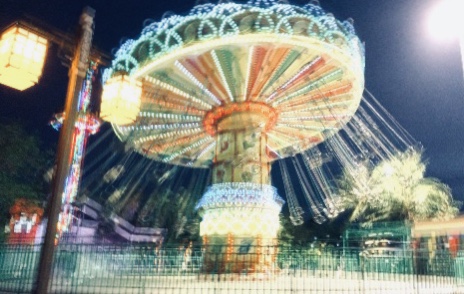
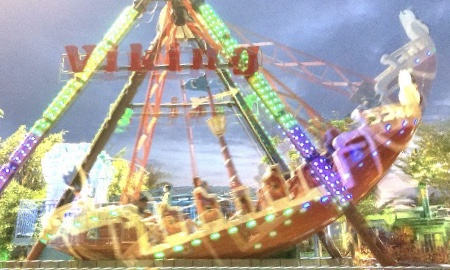
My own attempts of long motion shots:
Inspired by the examples and techniques of capturing motion. I’ve attempted taking sone photos at a local amusement park after dark, I was using a long exposure iPhone app:
Exercise 2
Photography is particularly suitable for portraying time due to its ability to capture reality, or the aura of what we see through the camera. As we’ve noticed in exercise 1, there are various techniques of capturing movement in photography. This can also be applied onto capturing life itself, for example: capturing the process of age-progression of a person, re-enactment of baby photos etc. We can also portray place over time, such as in the course example of Derek Trillo, Benzie Building, but this can be extended over longer periods of time, displaying time within the context of a single location.
Other creative arts can achieve time capturing effects, but as they require more time to produce, we would not be observing the most ‘realistic’ evidence of the moment as the moment has long passed by the time the artwork is complete. The ability of producing close to ‘instant’ images makes photography is the most authentic medium of time capturing. Secondly, using photography is the easiest technical way of mass producing images, or places or reality – The artist’s work is in seeking the perfect conditions for the ‘decisive moment’, but once you’re there, a single click can produce multiple images. Photography saves artists a ton of production time.
Exercise 3 – family photos
Just as seen in the Photo Omnibus project – Observing our own family or past photos raises powerful emotional response which can draw us back in time and allow us to reflect on those moments. Losing our family photo collection is a major personal disaster as those photos are not ambiguous objects, they’re considered a part of us, therefore losing them, might signify losing connection to our past and memories.
Destroying everyone’s family photographs would be a really cruel idea: Most Cambodian family photos were destroyed during the Khmer Rouge revolution, until today, people painfully feel that loss and long to be able see the lost images of their relatives and ancestors.
Write down how you feel about photos – or videos – from your family’s past. Will this archiving be affected by the digital revolution? Do you have images languishing on your hard drive that you keep meaning to process? Is flicking through images on someone’s phone or digital photo frame as potent as looking through an album or sorting through a box of photos? Or is it better?
I love looking back at my childhood and family photos. I grew up in the 80-90s, the last generation ‘blessed’ to experience an analog childhood. I was a happy child and those pics take me back to that place of emotional safety and simplicity. Digital photo formats means we can take, collect and archive more photos effectively, using less home space and clutter, but digital photos cannot be displayed without opening the files, so they lack some of the sentiment that exited in opening a dusty box or an album, flicking, holding and touching pictures certainly has its own magic and meaning. I believe it’s still best to print our favorite photos, hang them around our home and create old fashioned albums.
Documenting Journeys – Research Point
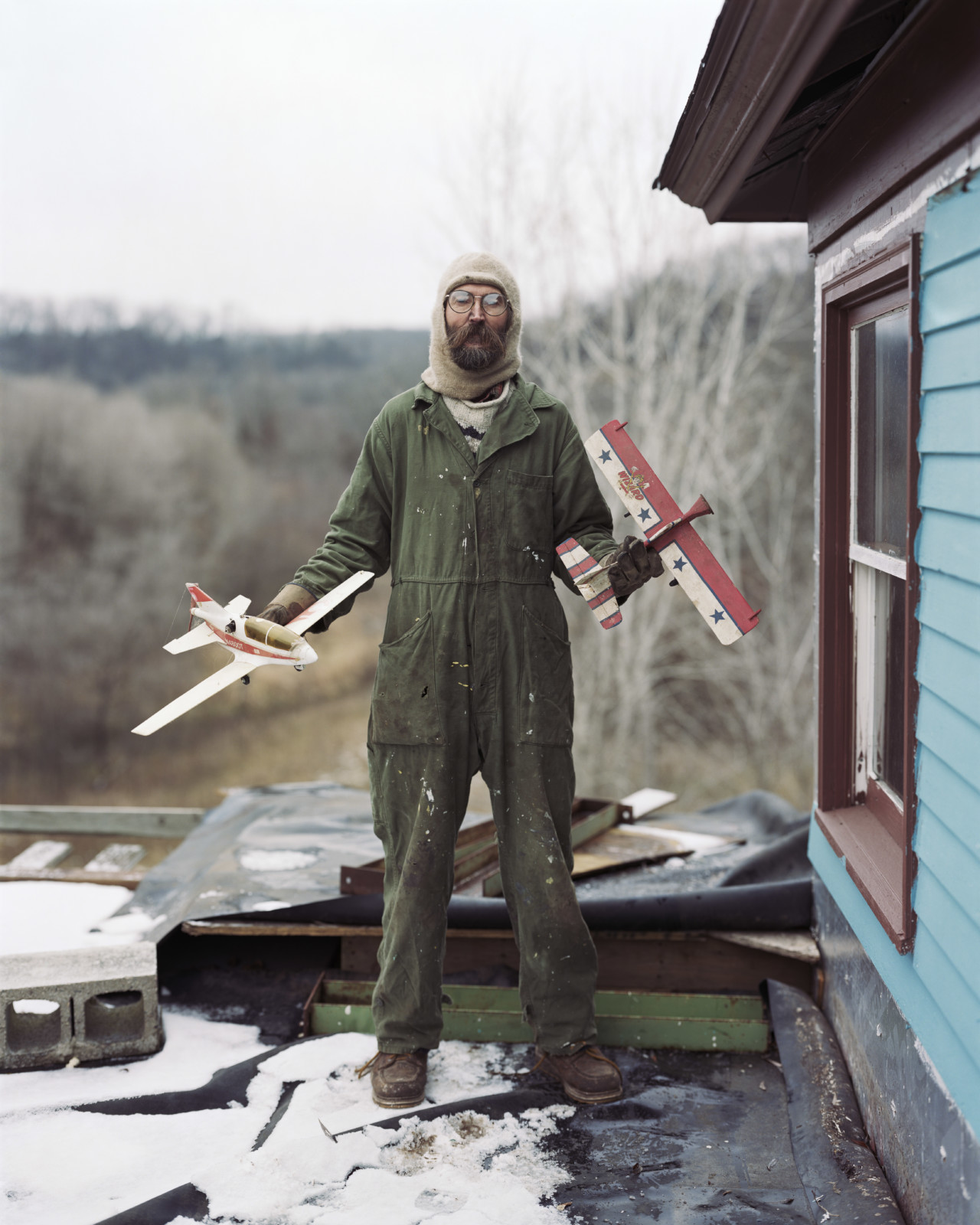
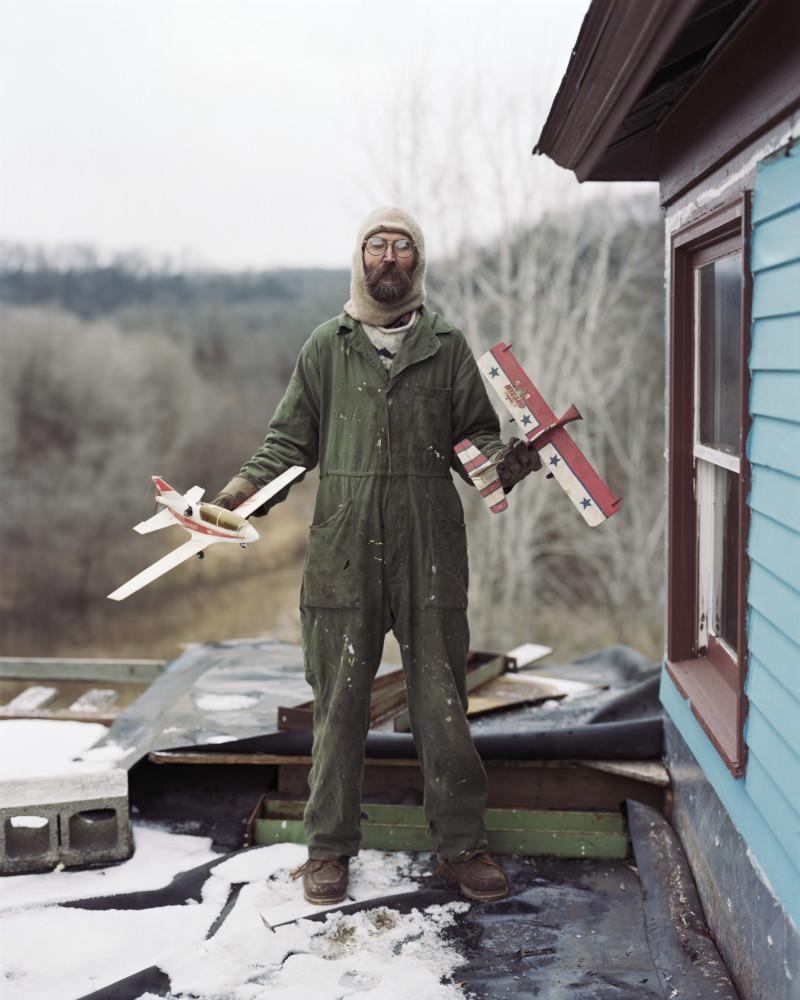
“Reflecting on the title, Sleeping by the Mississippi, he still sees in it a more lyrical way of moving through the world that hints at sleep and dreams. And indeed, “Sleeping is more about dreams and longing than it is about what is going on in America right now.”
“Portraits populate Sleeping by the Mississippi; characters imbued with a kind of mythological meaning, Soth’s images have rendered them mysteriously symbolic. Charles – perhaps one of the more well-known characters to inhabit the book, with his aviation gear and model airplanes – represents a “humble search for creative exploration” to Soth. “I want to be him!” he exclaims. To the photographer, at the time, Charles was proof that “living a creative life doesn’t have to be on an epic scale.”
“Soth recognises photography as a language: a language full of dialects, of which road trip photography is one, with its own grammar and vernacular, its set of references”
“Opposing essentialism, he doesn’t believe photography can convey a deep truth about a person. Instead, “a photograph merely is light reflecting off a surface” – a transient moment in time, impermanent.”
““I was a morose, introverted young man,” says Soth of his early years, identifying with a version of a Midwestern American sensibility that was “dark and lonely”. Working in a photo-processing lab on other people’s pictures throughout his early 20s, he had (almost) given up the ambition to become a famous artist, yet it was this very relaxation of his personal ambition that eventually allowed him the degree of freedom necessary to accept the influence of the American tradition of road trip photography in his own work – to stop pretending he was reinventing the wheel, to carry on the tradition and make it his own.”
“He began to follow the Mississippi River in his car, driving from place to place, letting himself progress towards locations he had vaguely researched and “using the river as a route to connect with people along the way.” These were the early days of the web and the development of his process ran parallel to the growth of the internet. “It was like web surfing in the real world” he says, “it was like trying to ride a wave.””
“A miraculous time in my life,” is how Soth describes this process. He felt warmly welcomed in the region; he was allowed into the intimacy of people’s homes.
“The symbols of religion he encountered everywhere in the American South, and which pervade his photographs, felt especially loaded. As the Mississippi goes south it becomes warmer and more open, he explains – he was photographing a melancholy landscape where he could visibly see the roots of the country music that was born here. “It’s so easy to be ironic and cool but the real stuff is still out there,” he says.”
“The experience of living with his mother-in-law is one that he credits as “giving him superpowers” – talking to strangers was nothing in the grand cycle of life and death. And photography was “a permission slip” – a reason for being there, for entering the lives of strangers, and taking their picture.”
Reference: Alec Soth for Magnum Studios, available on: https://www.magnumphotos.com/arts-culture/alec-soth-sleeping-by-the-mississippi/ accessed 24/7/2020

“American Surfaces is a series of 312 colour landscape-format photographs depicting vernacular scenes that American photographer Stephen Shore captured while on a dedicated road trip across America in 1972–3. Informal portraits, photographs of city and suburban streets, and images of domestic objects, meals and street signage are all among the subject matter featured in these works, which can be displayed sequentially in smaller groups or as part of the series in its entirety.”
“This seriesis the earliest example of the road trip projects documenting the social landscape of America that have formed a central part of Shore’s practice. Today, the exhibition is widely acknowledged as representing a key moment in the history of photography.”
“Reflected in the title of the work, the details recorded in American Surfaces are superficial, yet together they build a bold and insightful portrait of the social and geographical landscape specific to North America at that time. Prior to making American Surfaces, Shore’s work had focused almost singularly on New York, where he grew up. This project marked a formative point in his career when the concept of the road trip became – as it remains – integral to his practice: immediately after finishing this project he began his seminal series Uncommon Places (published 1982). The artist has stated that he set out to record ‘everything and everyone’ he came across (Stephen Shore, artist talk, San Francisco Museum of Modern Art, San Francisco, 23 February 2012,”
“Shore is recognized as being among the most influential post-war American photographers, and was included in the landmark exhibition New Topographics: Photography of a Man-Altered Landscape at the International Museum of Photography at the George Eastman House, Rochester, New York in 1975″
Emma Lewis (2014) , ‘Stephen Shore – West Palm Beach, Florida, January 1973’ – Tate Gallery Summery, available on: https://www.tate.org.uk/art/artworks/shore-west-palm-beach-florida-january-1973-p81308 accessed 24/7/2020
Personal reflection
Road trip photography is a great way of collecting a ‘real life’ collage of scenes, places and people. It is always exciting, as the photographer doesn’t know in advance what he’ll encounter or where he’ll end up. This point takes the viewers along on that journey of wonders and surprises. Reflections of places and the people within them. Each person is both a photo, a story and a piece of I remember encountering several examples of photographers documenting journeys through spaces during our course: While researching on Jeremy Deller, I had a look as his ‘It Is What It Is”, 2009 Project, Another time / place travel project was Shimabuku’s ‘Cucumber Journey’, ‘D’Est’ and ‘From the Other Side’, by Chantel Akerman 2002, although it involved filming beside photography. Further example is Rodney Graham’s ‘Aberdeen’.
Some examples of journeying through time in photography are actually capturing a brief, decisive moment and extending it into a different narrative, or context. One example of that use, can be seen in Stanley Forman’s famous photo Woman Falling From Fire Escape |1975. The subjects were being saved from a fire, but through the photo, they look as if they are swimming, or soaring through the air. Birthing fantastic, new meaning to the moment, turning it into something different: image reference
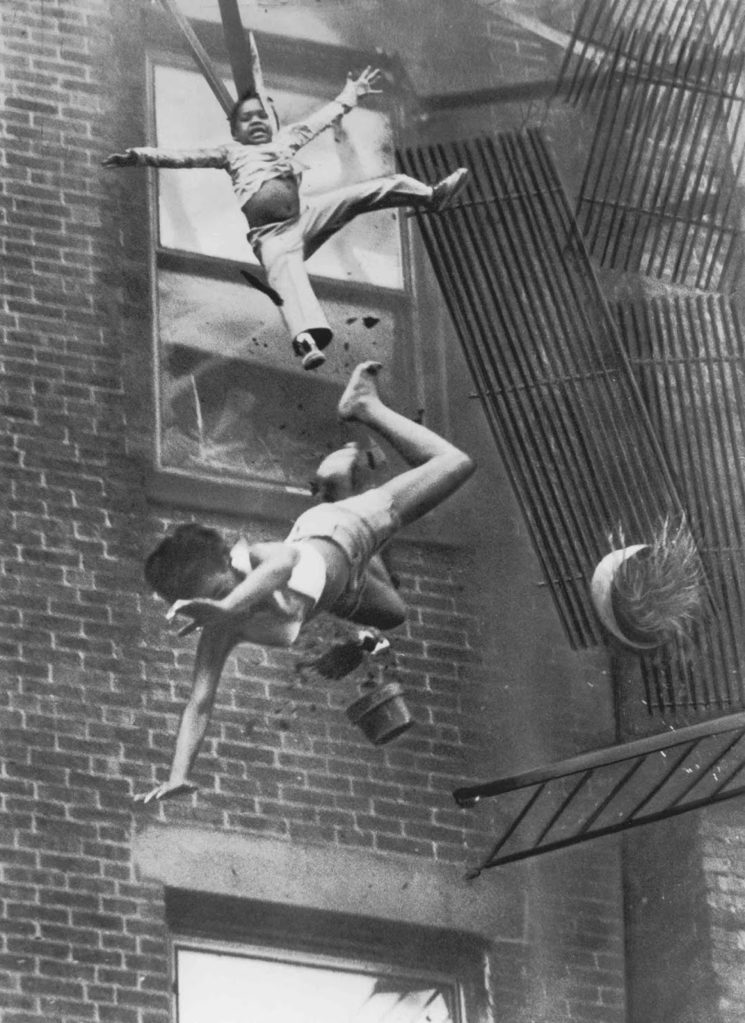
Stanley Forman, Woman Falling From Fire Escape |1975, available on: https://www.digitalphotomentor.com/20-most-famous-photographs/ accessed 24/7/2020
Photographer Tian Li, became well known once he published an extended project of taking a photograph, in the same pose with his son every year over 28 years.
“Every one of us is journeying through time and journeys are often the start of stories” This quote takes us back to the journeying through time we did in part 2, through text, poetry and literature, poems such as ‘Fern Hill’ and ‘The Road’ life journeys are very capturing and emotionally moving.
Photography and land art – Research Point

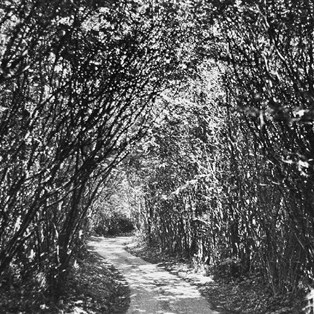
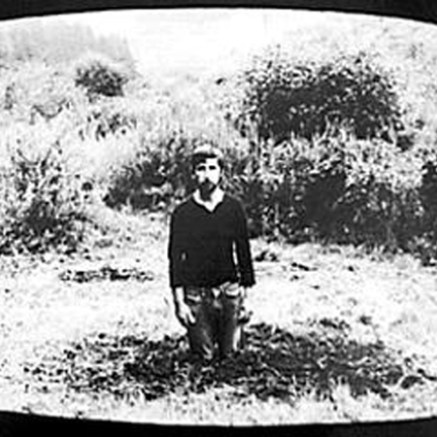
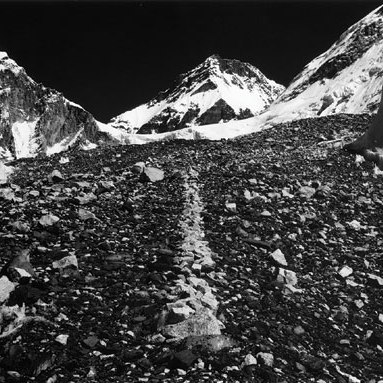
Top: Aleksandra Mir, First Woman on the Moon, Produced by Casco Projects, Utrecht on location in Wijk aan Zee, NL, 28 Aug 1999, available on: https://www.aleksandramir.info/projects/first-woman-on-the-moon/ accessed 26/7/2020
Bottom left: Hamish Fulton, Whitehill Wood 1976, available on:http://www.artnet.com/artists/hamish-fulton/whitehill-wood-S9GL86TOGhyGTYETlhuQuw2 accessed 26/7/2020
Bottom middle: Keith Arnatt
,Self-Burial 1969(Television Interference Project)
 available on: https://www.tate.org.uk/art/artworks/arnatt-self-burial-television-interference-project-t01747 accessed 26/7/2020
Bottom right: Richard Long, A Line in the Himalayas, 1975.
Photograph documenting work in the Nepalese Himalayas, available on:https://sculpturemagazine.art/ideas-can-last-forever-a-conversation-with-richard-long/ accessed 26/7/2020
Due to it’s momentary and provisional nature, photography seems to be an integral part of Landscape / Walking / Journeying art as well as or any other type of ephemeral or conceptual art projects.
The linked with photography, has several reasons:
Most obviously: photography is a documentation power: A photo, has the natural capability of preserving ‘a moment in time’ therefore, it is a natural tool to be used in transient projects such as land art. As land art disintegrates, the photos of the art work remain.
Photography is used for capturing the work’s original image, in specific time and view point chosen by the artist, along with text which portrays the artist’s concept, interpretation and ideas. The combination of displayed photography along with concept texts is used for efficiently displaying provisional art as time passes, rendering it eternal and therefore accessible in future generations, regardless of the work’s period or production date.
Additionally the photographic documentation of art work, allows complex land art such as stone sculptures and land lines it to become easily reproducible and sharable and discussed over multiple mediums, such as photo books, news articles and web blogs.
Finally there is another point of indication that project photography is a part of the art by itself and not simply as art documentation. Separate thought and meaning are observed in accordance to the compositions and perspective of each photo, this is particularly notable in Richard Long’s and Hamish Fulton’s art photo compositions, in which aesthetic value and visual beauty can be appreciated, therefor the photos themselves are recognized as independent art works.
 Creative Arts Today