Part 1
Image, Word and Dreams
The power of combined narratives
___
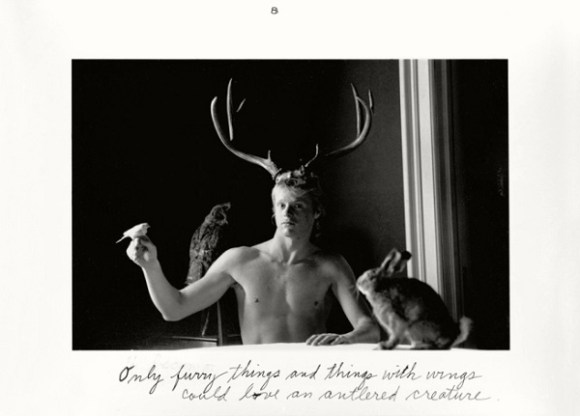
1*“I think photographs should be provocative and not tell you what you already know. It takes no great powers or magic to reproduce somebody’s face in a photograph. The magic is in seeing people in new ways.”
Duane Michals
One of the key elements, validating photography as an art form, is its influence on our emotions and inner world. 2* “Looking at pictures is, in this sense, akin to dreaming or the drifting consciousness experienced in moments of reverie. Advertising and pornography clearly play off this odd condition somewhere between waking reality and dream or fantasy.”
By definition, artworks are “intended to be appreciated primarily for their beauty or emotional power” (Oxford dictionary). Unquestionably, the viewing of photographs can trigger both visual appreciation as well as an emotional experience.
Innovative art photographer Duane Michals, had pioneered the medium by exploring beyond photography’s traditional focal points on scenic objects and decisive moments, he created 3*“his own visual vocabulary that told peoples’ stories in series of pictures”. He used devices such as sequential storytelling and combined imagery with drawings, texts and prose, his experimentations led to changed contexts, conjuring new narratives and deep emotion. 4* “Perhaps Michals’ most significant creative achievement is the precise coordination between his prose voice and his imagistic sensibility.”
Background in brief: b 1932 in Pittsburgh, received a bachelor of arts degree from the University of Denver, Colorado, followed by studying graphic art in New York. His life changing encounter with photography occurred during a trip to the Soviet Union with a camera borrowed from a friend. He became a successful commercial photographer in the late 50’s with his first New York exhibition held in 1963.
Michals’ describes his photographic skill as completely self-taught. It is conceivable that his ingenious and originality were partly founded in the fact he never received formal training, or was burdened by the rules or confines of a single medium. *4“Relying instead on his intuitive creativity and expressive needs–albeit influenced by such Surrealist painters as Magritte, de Chirico, and Balthus, and by writers of magic realism and metaphysics.”
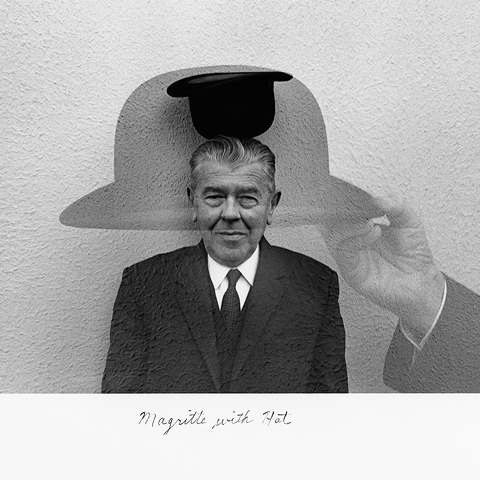
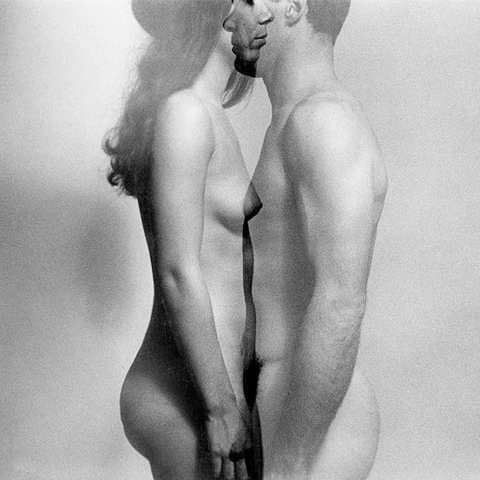
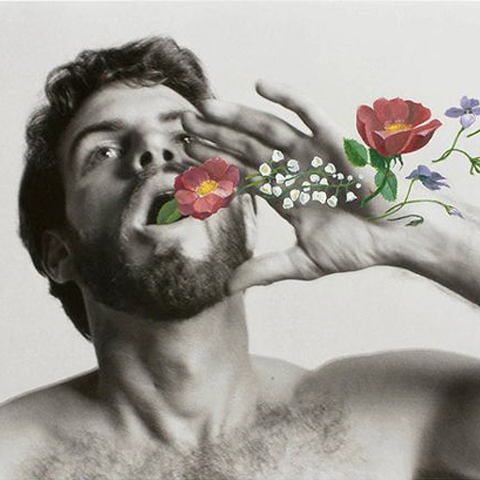
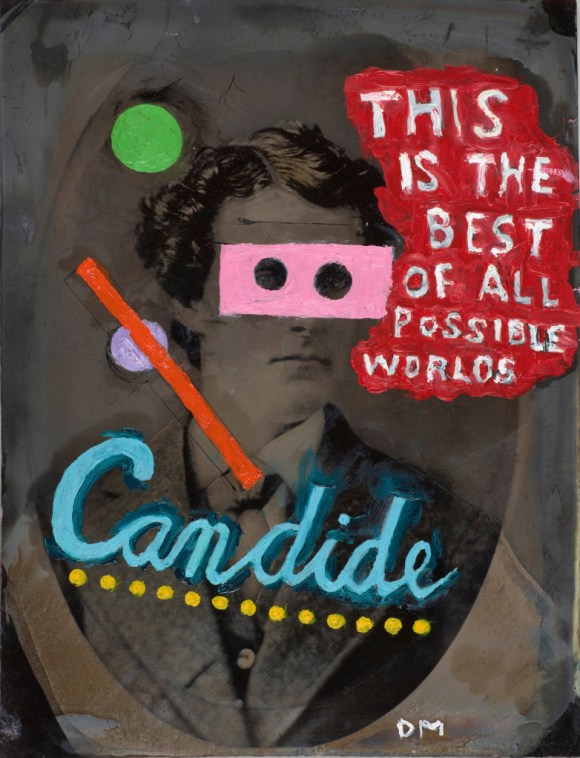
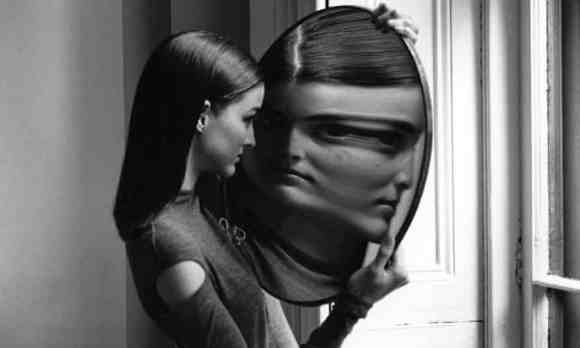
Since the 60’s, Michals focused not on what you see, but on conveying the way it made you feel. He examined methods of elevating the communicative capacity of his photographs, devices he tested include juxtaposing, reflections, collage, sequential narratives and writing texts and drawing on photographs. “*4”Michals reintroduced such photographic tricks and techniques as double exposure, blurring, and mirror image, at that time disdained by mainstream photographers.” The results were wonderfully surreal and very different from the typical photojournalism ideas that dominated photography in 60-70’s. Observing examples images below, left to right: We find juxtaposing and long exposure in his famous “Prose portrait” of Rene Magritte: ‘Magritte with Hat’, 1965. image link,with is clearly influenced by ‘Son of Adam’, samilar technique used in ‘Adam and Eve (Male and Female)’, 1963. Gelatin silver print with hand applied text, image link, ‘Primavera’, 1984. Is a Gelatin silver print with oil paint drawings. image link, Collage and drawing was used in ‘Candide’, 2019, Inspired by Voltaire, © Duane Michals via DC Moore Gallery Image link, Mirror reflection was used in the sequence: ‘Dr Heisenberg’s Magic Mirror of Uncertainty’, 1998, by Duane Michals, shot for French Vogue, Image link
Gradually, text gained a fundamental place in Michals’ practice as a device of semiotic intertextuality, transcending discourse beyond the visual, Lynda Nead (1988: 4) defined discourse as *6 ”a particular form of language with its own rules and conventions and the institutions within which the discourse is produced and circulated.” Discourses are articulated in the way that the meanings of any one discursive image or text depend not only on that one text or image, but also on the meanings carried by other images and texts.
The photos below demonstrate how new narratives are formed out of intertextuality. By observing the initial visual response to these photos followed by a surprising alteration as we read the combined text, which reveals a far deeper narrative and information that engages our thought, heart and imagination. In his words: *5”Sixty per cent of my work is photography and the rest is writing.”
 “A Letter From My Father, 1960/1975” by Duane Michals (courtesy of the artist and Carnegie Museum of Art, Pittsburgh) Image ref “A Letter From My Father, 1960/1975” by Duane Michals (courtesy of the artist and Carnegie Museum of Art, Pittsburgh) Image ref |  Frame #3 of 3 from the series “Madame Schroedinger’s Cat, 1998” by Duane Michals (courtesy of the artist and Carnegie Museum of Art, Pittsburgh) Image ref Frame #3 of 3 from the series “Madame Schroedinger’s Cat, 1998” by Duane Michals (courtesy of the artist and Carnegie Museum of Art, Pittsburgh) Image ref |
I believe the magic in Michals’ photography is conjured by several key devices:
Firstly, the photo & text narrative sequence format has distinct theatrical / cinematic attributes, making a perfect vessel for storytelling. I find it highly imaginable to visualize Michals’ photo series turned into an ‘Avant Garde’ short film, as each photo constitutes a scene where events take place while the text has the role of conducting our narrative experience. We find representation of ‘Time’ in the element of continual timeline, similarly to other sequential visual communication formats such as storyboarding and comic strips.
Secondly, Michals’ parables are open-ended, leaving room for proactive interpretation and emotional response. His storytelling revolves around universal components of the human emotional experience: search of fulfilment, love, rejection, loss and death. His subjects are generally deficit characters who are realistically imperfect, hence the result is dramatic, relatable and captivating. *4”His photographic sequences have a film-like appearance and represent intangible elements of dreams, imagination, death, time, myth and spirit.“
Lastly, The match between semiotic visuals and text narrative creates profound *11‘intertextual expansion’ and the type of discourse which successfully touches our most inner subconscious emotions: *4“Duane Michals uses visual narrative, symbolism and metaphysical imagery to interpret the human condition.” Michals’ originality, active philosophy and witty point of view on life and art, highlights the importance of focusing on expression. He continues to incarnate his unique creativity well into his eighties: *12“Don’t try to be an artist. Find the thing within you that needs to be expressed. You might find it is art.”
Part 2
Throughout our unit, we’ve gathered that photography is a medium closely linked to time and place. Certain connection to time was obvious, due to the element of instant capturing of reality. Several other examples that illustrate the connection to time are photography’s capability of preserving the transient and capturing the temporal as we’ve seen in examples like childhood / family photography, documentation of journeys and land art projects. The interactive ways photography enabled the capturing of movement in time was well explained in project 2. Exercise 1, where we examined how photos may freeze a fracture of a moment as seen in Harold Edgerton’s ‘Bullet and Apple’, c.1964, Bridgeman Images or either condense a length of time into a single frame as in Derek Trillo’s, ‘Benzie Building’, 2013 or in Daniel Meadows’ idea for the ‘Free Omnibus Project’.
10*“The frame of the photograph encloses a space, a world, which we can enter (in our imaginations).” In regard to place, photos can offer such unique perspectives of Place, from the ability of allowing us to visually explore the places we’ve never seen, to drifting our minds back in time, to the places of our past or historical events. Photography creates unique perspectives of seeing landscapes, we noted how different point of view and vantage can include devices of expression, beyond that point, photos demonstrate that people become an integral part of landscapes, this is especially obvious in Photo Journeys, where we often see people captured within a place.
This unit has been interesting for me as Photography has always been a part of my art as I often stage what I wish to paint, or find inspiration by photos that I see. In my view, the exercises showed an array of interesting ideas and projects that show various potential ways of applying photography as an artist. I am quite intrigued by the concept of land art and I may wish to note some ideas for land art projects on a lovely piece of land that we own in the highlands of Cambodia. Moreover, I would probably think differently the next time I travel, my perspective on photography would definitely be influenced by this unit’s impressions of ‘Photo Journeys’.
Working on this assignment has been completely inspiring and I’ve learned so much through my research. I’m absolutely fascinated by Michals perspective, I wish to draw some inspiration from his engenius ideas and potentially attempt including texts and prose in my own artwork. I love the effect created by Imagery – text 11* ‘intertextual expansion’ as I find it so deeply emotional, even therapeutic. Other interesting aspects I may wish to explore, are results of different varieties of intertextuality, such as Imagery with Music, or Poetry with music.
Finally, I believe that my active steps overcame the course timeframe concerns that were expressed in my previous assignment. I had put in extra time and efforts to get back on schedule, leaving 6 weeks to complete our last unit and I now see it as a lesson in time management as I move forward on my learning journey.
References:
- Art Blart: Exhibition: ‘illusions of the photographer: duane michals at the morgan’ at the morgan library & museum Link.
- Edwards, S. (2006) Photography: A Very Short Introduction. Oxford: Oxford University Press
- Art Blart, Exhibition: ‘illusions of the photographer: duane michals at the morgan’ at the morgan library & museum, by Marcus Ban Link
- Duane Michals: photographer, storyteller. David B. Boyce, 02 2003 (Essay) Link
- The New Yorker / Portfolio, The Last Sentimentalist: A Q. & A. with Duane Michals Photographs by DUANE MICHALS Introduction by SIOBHAN BOHNACKER Link
- 1000 Word Mag, At the PEM: Pioneering photographer Duane Michals told stories with pictures, by Chris Bergeron, Mar 19, 2015, Link
- Visual Methodologies, by Gillian Rose, 2001, figure 1.4,
- CLOSE ENCOUNTERS OF THE DUANE KIND March 24, 2015 by Link
- DC More Gallery, Duane Michals: Sequences & Talking Pictures, Press release May 5 – June 11, 2016, Link
- The Pencile of Nature, William Henry Fox Talbot, 1844-46, Link
- Music Therapy – Integrating words, images, and text in BMGIM: Finding connections through semiotic intertextuality, Alison Shorta ; Heather Gibbb ; Colin Holmesc, First published on: 26 April 2010, Link
- https://www.theguardian.com/artanddesign/2015/feb/26/duane-michals-best-photograph-french-vogue-quantum-physics-heisenberg
 Creative Arts Today