Research point- Slow Design
Slow Design Principles
REFLECTIVE RITUAL
Embracing ritual beyond the commodified time of industrial production. These designs offer diverse expressions of ritual and different time experiences. Using rituals to create a better user experience
Principle 1: REVEAL
Slow Design reveals spaces and experiences in everyday life that are often missed or forgotten, including the materials and processes that can easily be overlooked in an artefact’s existence or creation. Creating awareness, uncovering the essence of a product.
Principle 2: EXPAND
Slow Design considers the real and potential ‘expressions’ of artefacts and environments beyond their perceived functionality, physical attributes and life spans. Give a bigger picture: zoom in (what is it made of) and zoom out (where does it come from).
Principle 3: REFLECT
Slow Design artifacts/environments/experiences induce contemplation and what slowLab has coined ‘reflective consumption.’ Product designers are questioning not only ecological values, but also perceptual and emotional experiences that the unique materiality of products can deliver.
Principle 4: ENGAGE
Slow Design encourages users to become active participants in the design process, embracing ideas of conviviality and exchange to foster social accountability and enhance communities. Create design opportunities so that the user can re-design and re-configure the product. The user is active during the use of the product.
Principle 5: PARTICIPATE
Slow Design encourages users to become active participants in the design process, embracing ideas of conviviality and exchange to foster social accountability and enhance communities.
Principle 6: EVOLVE
Slow Design recognizes that richer experiences can emerge from the dynamic maturation of artifacts, environments and systems over time. Looking beyond the needs and circumstances of the present day, slow designs are (behavioural) change agents.
Slow design principle projects, seem to be designs existing outside the commercial and financially pressured realm. The concept seems lovely as is encourages activating thought, reflection , action and social interaction. Slow Design projects qualifies as a form of practical meditation creative group art therapy. Additionally, it takes on and demonstrates sustainability, efficiency and production cycle transparency.
I’m not entirely sure slow design products would be feasible or competitive in the broad, commercially driven market environment. But I suppose that isn’t the focus and assume one would probably have a ‘day job’ while participating in slow design.
Slow Design Products would have great appeal with ideological consumers as well as those seeking sustainable and original products. The open invitation to get involved is additionally attractive and playful.
“What we have here is a post-industrial nostalgia for the pre-industrial. In a culture with a surfeit of branding and cheap mass-produced goods, we romanticise the handmade because we yearn for quality, not quantity.”
Exercise 1
The art of craft: the rise of the designer-maker, available at: https://www.theguardian.com/artanddesign/2011/aug/01/rise-designer-maker-craftsman-handmade accessed 20/12/2020
my notes:
“What’s new is the desire to reveal the process and not just the finished object. These are not-so-subtle messages reasserting the value of the handmade over the machine-made.”
“homo faber, or “man as maker”, “the hand is the window on to the mind” ( Immanuel Kant’s dictum).”
“since the industrial revolution, the designer and the craftsman are traditionally different roles.”
“The conspicuous consumption that defined the second half of the 20th century was driven by mass production; by men (though not always men) in charge of machines. And what Karl Marx called “commodity fetishism” – that ineffable something that gives an object a perceived value greater than its actual material cost.”
“Like many designers of his generation, Fastrez is rejecting the one-size-fits-all outcome of traditional manufacturing. In his case, he is appealing to a growing taste for customisation – one that new production technologies are making ever more realistic.”
“A number of the designers expressed how important they felt it was to make things with their own hands. This is partly an ethos – much like the slow food movement – but it is also a necessity.”
The problem with craft, of course is that it’s expensive. his is how much global economics prohibits the idea of accessible craftsmanship, at least in the developed world.
There’s no real question of returning to a craft-based economy (or only in the darkest fantasies of a global economic meltdown). What we have here is a post-industrial nostalgia for the pre-industrial. In a culture with a surfeit of branding and cheap mass-produced goods, we romanticise the handmade because we yearn for quality, not quantity. The irony is that while western consumers aspire to craftsmanship, the majority of the world’s population lives in countries that have local craftsmen but aspire to industrialised products.
Conclusion:
There is definitely a growing demand for craft-based and individually designed goods, most people love the uniqueness and quality of hand made objects and see extra personal value in supporting something other than mass-production.
Additionally I would say that most people aspire and take pride in making purchases that support the livelihoods of individual craftsman, designer-maker or artisan, rather than the industrial corporation. There’s a certain type of idealism and nostalgia in considering the background tale of a hand made object, there’s a different energy to it.
Unfortunately, craft work and products aren’t always affordable, therefor not always optional to those under more economical pressures: individuals with families, singled parents and the elderly, are less able to afford to invest in slow products on a regular basis.
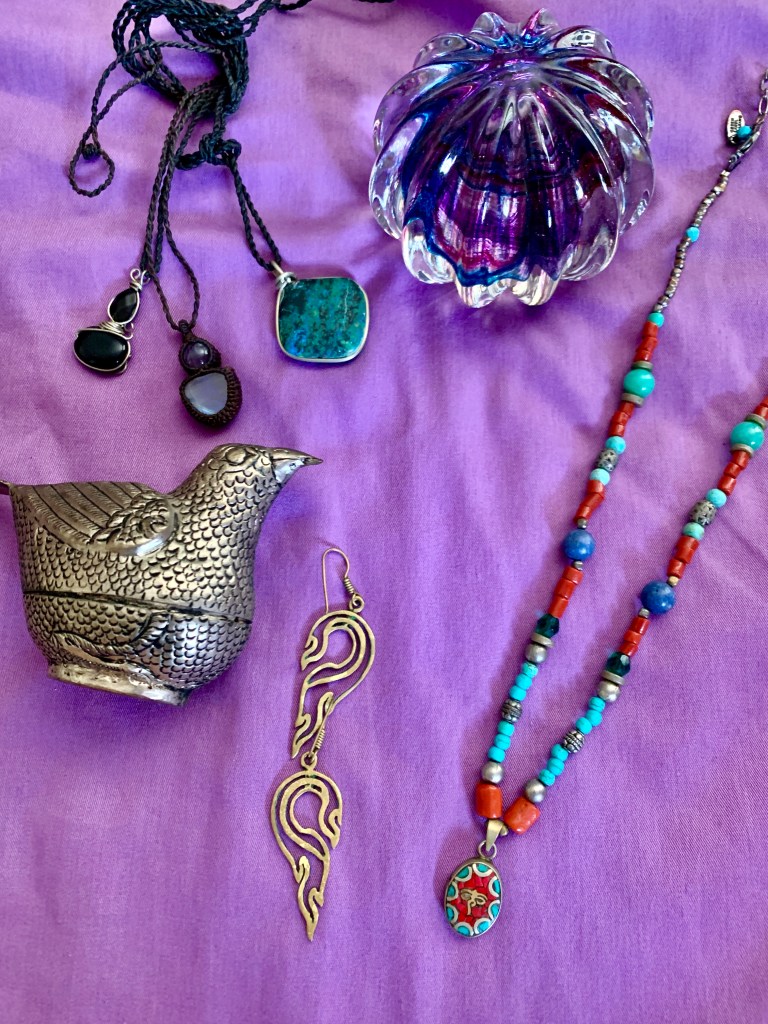
I live in Cambodia, a place full of local craftsmen and domestic production. In this part of the world, slow design and craft items are completely affordable. I have a huge collection of items, like custom clothing I designed and produced at local seamstresses, jewelry I either made myself or bought from friends I wanted to support, you can even order your custom made dream shoes here ! It’s totally affordable! All made by local as well as expat craftswomen and men.
I’m a huge fan of craft and can absolutely testify on the therapeutic power of peaceful crafting. Making things is something rooted in the essence of being human, in our sense of purpose and development, this is the reason it is so naturally good for our mind and soul to be involved in crafting.
Research point:
What is their craft and how do they approach it in their work?
• Do they adhere to the ideas of Slow Design? To what extent does this allow them to take risks, experiment and innovate?
• Is their story or the story of their work important? Why?
• Do you value ‘craft’ and craftsmanship? Why or why not?
• Is there room for craft in modern society?
Make notes in response to these questions in your learning log.
My choice for designer resarch is Johannesburg based designer: Pascale Theron, who creates unique fabrics fashion items by weaving, knitting and sewing different types of feathers. I found Pascal on Instagram and was absolutely fascinated by her unique feathered-fabrics, her work is quite revolutionary, evolving extensive research and risk taking, as she attempts to create new materials that could innovate the fashion industry and potentially make a different towards animal welfare. She is inspired by her own experiences, culture and identity, as well as research, physical and social environment. Here are some of her reflective statements, pointing towards elements from the Slow Design movement: “I delve deeply into my research and enjoy connecting with people from different backgrounds, attempting to create a bridge between cultures. I believe it is of utmost importance to design meaningful products that not only use intuition, but are also sensitive and genuine. I also enjoy working with soon-to-be-lost handmade crafts. Creating cultural products that fall somewhere between art and design.”
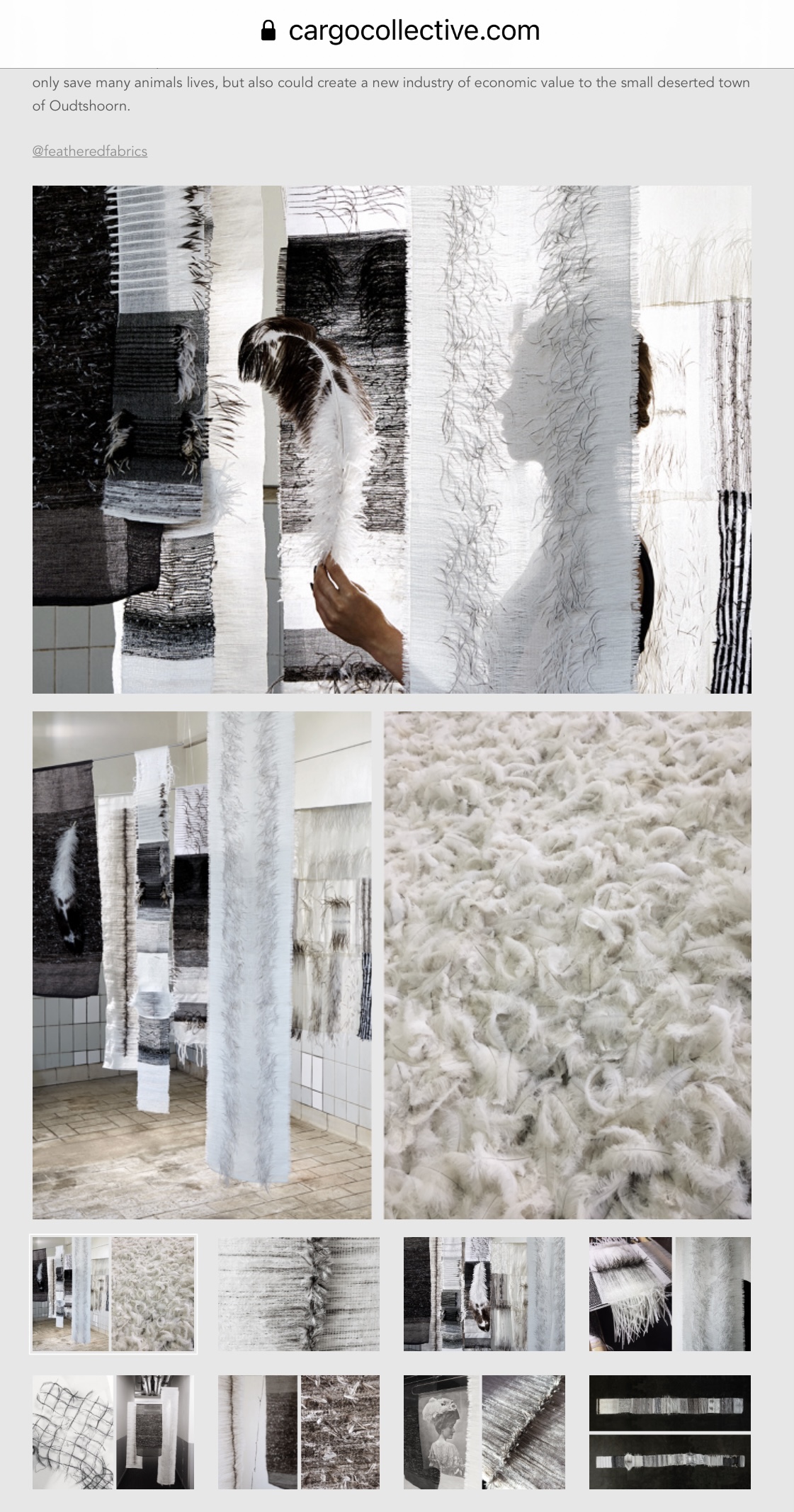
Each art and fashion piece is is produced by Pascale, involves several slow design principles: Each item is hand made by different crafting techniques, with expansive and well thought originality. The materials, feel well connected to African environment, the animals and the people it is made by. It seems that countless experiments and risks were taken in order to achieve such intriguing textiles and product textures.
Feathered textiles holds a very interesting story of a ‘rediscovered’ material, they are important as they introduce groundbreaking ideas for improving the state of animal welfare: The Collection of feathers from the ostrich is the equivalent to cutting fingernails causing no pain to the bird. By creating new ostrich interior and fashion textiles, as well as new ‘fur’, it is possible to reduce animal death usually associated with fur.’ Another benefit is for the ostriches themselves, giving ostrich farmers a financial incentive to raise ostriches to a full life span.
I absolutely value crafts and craftsmanship, I believe they’ve always been important parts of society and interactive social circles. Multiple craftswomen and men, are responsible for important innovation in design, sustainability and materials technology. Additionally, are healthy and meditative, therefore fundamental to human mental health and our natural creative expression.
 Creative Arts Today