Introduction: What is art?
“For somebody just to walk into an art gallery and expect to understand it straight away, it would be like me walking into, I don’t know, a classical music concert you know, knowing nothing about classical music and saying oh it’s all just noise. It is quite tricky sometimes to get into the position where you can start to understand because you can intellectually engage with something quite quickly but to emotionally and sort of spiritually engage with something takes quite a long time. You have to live with it.”
Grayson Perry, Reith Lecture 1, BBC, 2013
Notes on : Grayson Perry: Playing to the Gallery
Keywords:
Quotes:
Art, Comtemporary, definition
‘(Art)It sneaks up on people and seduces them (and I like that )’.
‘(Art) Liven and explains the way we live today.”
‘Historically, the art world had been inward looking, a closed circle of the artist – gallery – collector’. Many people are intimidated by the art world / art language.
Many methods of judging art are problematic and conflicted: Financial value, popularity, art historical significance, sophistication. There’s tension between quality and popularity.
A key textbook for Creative Arts Today, is:
‘Dean, T, and Millar, J. (2005) Place. London: Thames and Hudson.
Exercise 1: Fountain
Marcel Duchamp, Fountain, 1950 (replica of 1917 original)
(porcelain urinal).
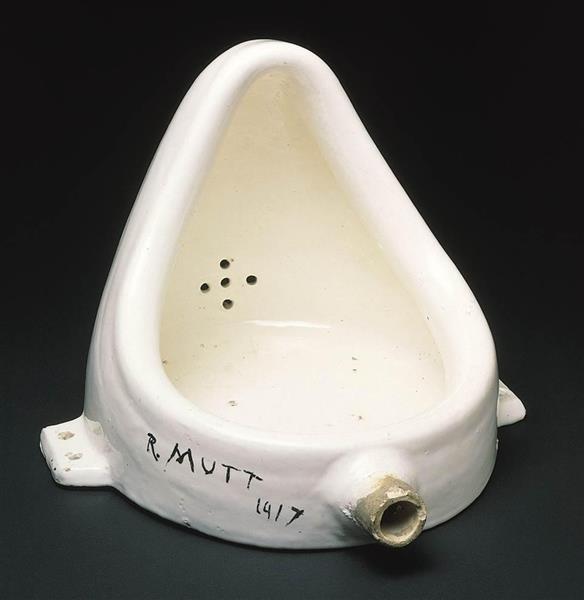
Marcel Duchamp, Fountain, 1950 (replica of 1917 original) (porcelain urinal), Image available at https://www.oca-student.com/sites/default/files/oca-content/course-pdfs/cg_ca4cat_270319.pdf accesses 12/2/2020
My impression: I can observe the type of art piece intended to confront the viewers with their own reflection, senses and emotions. I am not personally revolted by bodily functions, so my feelings are neutral, though I’m neither impressed nor moved while looking at it.
• Is technical skill an important quality in an artwork? There are many types of art and artistic expressions. Certain contemporary art is based on perspective and questioning from the viewer’s perspective, not necessarily involving a display of technical skill.
• Do you think art needs to move you emotionally? Basically yes. It should have some type of effect, yet not all art would affect people in a similar way. Viewers would and should have different responses as not everyone feels in the same manner.
•Does art have to be unique? Almost every art work produced is unique in some way, as there are multiple ways for interpreting the essence and definition of unique.
Exercise 2: What is art?
- Art is any form of displayable creation or installation. .
- We know it is art – by judging whether it had been produced in order to be viewed, if the answer is yes, it is probably art. There are infinite art forms and infinite artistic intentions, yet what they share in common is that all were produced as a personal expression to be seen, heard, felt and processed by others.
- Who decides what is art? Art is a complex and a limit-less communication language. I believe anything could qualify, as long as it’s been created or performed in order to be displayed or seen, if it makes another ( the viewer ) feel any response at all, it could be a form of art. We could even find definitions of art in the animal kingdom: For example: Displays such as mating dances, or a fancy nest construction could qualify as animal produced art.
- Is it enough just to display a found object and say ‘this is art’ because it’s in an art gallery? As long as the displayed object had been produced or placed to be viewed and processed by others, yes, it could qualify as art.
- Duchamp said he wanted “to put art back in the service of the mind”. What do you think he meant by this? Duchamp’s piece : “Fountain” is completely open to individual interpretation. Being composed of a banal, everyday object – It can spark random emotions or associations and which activate the mind & individual feeling of the viewers. This seems to have been a part of his intention.
Exercise 3: Reading about art:
Reference Note:Art History: The Basics by Grant Pooke and
Diana Newall (2008, Abingdon: Routledge). The first few pages (pp.1–8)
Reading notes & glossary:
Duplicity ( Deceitfulness)
acquiescence ( the reluctant acceptance of something without protest)
arbitrary ( Based on random choice or personal whim rather than any reason or system)
“There really is no such thing as Art. There are only artists.” p 4 (Gombrich 1984: 4)
Fine art: Traditionally been used to distinguish arts
promoted by the academy, including painting, drawing and sculpture.
Decorative arts: Works created for a function – such as ceramics,
jewelry, textiles, needlework and glass work.
A broader definition of art : Encompasses those activities
which produce works with aesthetic value, including film
making, performance and architecture.
Contemporary definitions of art are not medium specific.
It recognizes that art can be a term designated by the
artist and by the institutions of the art world, rather than by
any external process of validation.
ll definitions of art are mediated through culture, history and language. To understand these differing concepts of art, we need to look at their social and cultural origin.
Exercise 4: Looking at context
• My your first reaction to the piece: It is impressive and emotional. I feel saddened by the use of wildlife in this piece, it could’ve been replaced by a replica.
• Do you have an emotional response to it? The shark looks very much alive, which sets an emotional alert as a response. While the rational mind contradicts with the notion of the shark’s absolutely confirmed death.
• What do you think it’s about? It seems to me that the direct emotional contradiction is a bit of a “gimmick”. But it absolutely works in setting in philosophical questioning on life, fear and death.
• What do you think about the title? It is an important part of the piece. Interesting and befitting, it helps direct us in the intended course of thought.
Exercise 5: Finding out more
Whilst making your notes listen for information about:
• Hirst
• The piece
• Hirst’s other work
• Information on other artists whose work is concerned with mortality
• References to ‘time’.
Contextual information is data that gives context to a person, entity or event. In other words, context-awareness is the ability to extract knowledge from or apply knowledge to information.
Damien Hirst is a very well known contemporary artist. He’s produced famous, revolutionary/ shocking and debatable art work.
The piece exists in both the physical form and philosophical form. The name is a large part of it’s essence and questioning. It’s scary to look at while raising profound questions.
Damien Hirst regularly uses animal bodies in his other artwork: Sheep, butterflies and more. He’s unpopular with certain viewers who are also animal rights activists.
It makes your mind jump back and forth as well as raise philosophical ideas and primal fears.
The original shark decayed despite Hirst’s preservation attempts. It is unclear if that was intended or not.
Many art works are a form of attempt to transcend life ( beyond death ). Starting in ancient times, the mummies of Egypt for example.
In today’s modern art world: There are profound philosophical questions being asked, sometimes there are certain aspects of cynicism, or intentional shock. Certain viewers might speculate a grand joke might be played.
 Creative Arts Today
One reply on “Project 1: Art and ideas”
[…] n my initial response : As I look at into my initial answer – My views haven’t essentially changed, yet I feel tools were gained and my tolerance […]
LikeLike